



Self Breast Exam: A Simple Guide Every Woman Should Read
Posted By Dr Farah Arshad | Female Breast Surgeon in Lucknow
Because knowing your body can save your life
Most guides tell you what to do. This one tells you why it matters — and what most guides quietly leave out.
What Is a Self Breast Exam?
A self-breast exam is simply you, checking your own breasts for anything that looks or feels different from usual. It takes about 10–15 minutes. You don’t need special equipment. Just your hands, a mirror, and a few minutes of privacy.
It won’t diagnose cancer. But it builds body awareness — and that awareness is what helps you catch changes early.
How to Do It: Step by Step
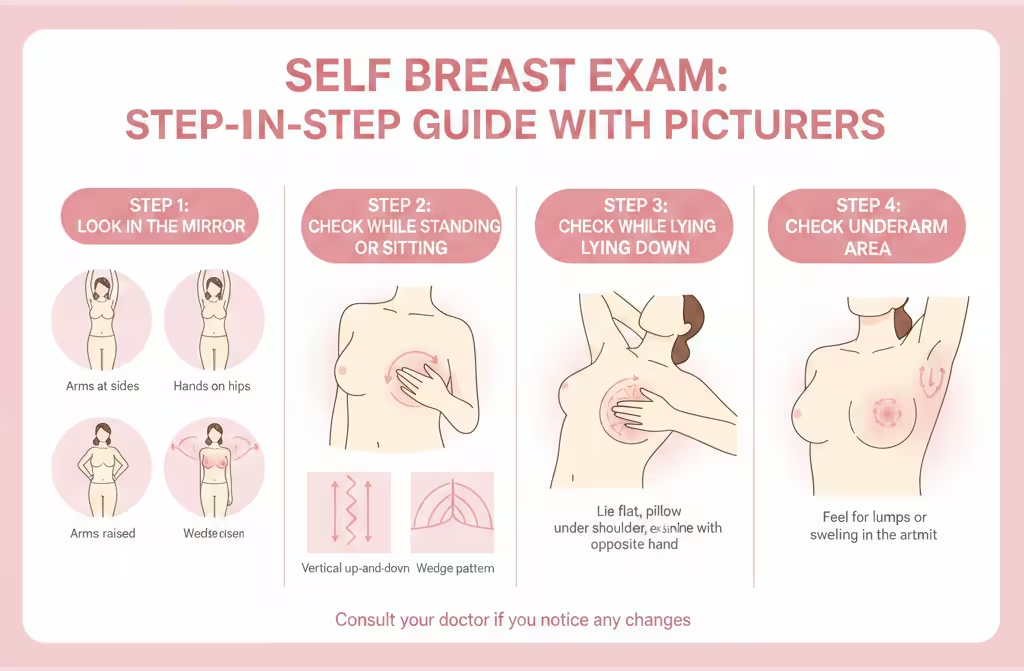
Step 1 — Look in the Mirror
Stand without your top or bra. Look at your breasts in three positions:
Position 1 — Arms relaxed at your sides Position 2 — Both arms raised above your head Position 3 — Hands pressed on your hips (this tightens chest muscles and reveals hidden changes)
Look for:
- Skin dimpling or puckering
- One breast looking different in shape or size (new change)
- Nipple turning inward (when it didn’t before)
- Redness or swelling on one side
Simple truth: Many early cancers don’t change how skin looks. So seeing nothing unusual doesn’t mean everything is fine. This step is just one part of the process.
Step 2 — Feel While Standing (Best Done in the Shower)
Wet skin lets your fingers glide smoothly, making it easier to feel changes.
Use the pads of your three middle fingers — not your fingertips, not your palm.
Move in small circles, starting light, then medium, then pressing deeper. This helps you feel tissue at different levels.
Cover the entire breast area:
- From your collarbone down to your bra line
- From the middle of your chest to your armpit
- Don’t forget the armpit itself
Which pattern should you use? Pick one and stick with it. Consistency matters more than which pattern you choose.
What most people get wrong: Going too fast. A proper exam takes 5 to 7 minutes per breast. Most people spend less than 2 minutes total.
Step 3 — Feel While Lying Down
Lie flat on your back. Place a small pillow under your right shoulder. Raise your right arm above your head.
Now feel your right breast using the same circular finger motion.
Switch sides and repeat.
Why this position? When you lie down, breast tissue spreads out and flattens. This makes it easier to feel deeper changes close to your chest wall — changes you might completely miss while standing.
When Should You Do It?
| Your Situation | Best Time to Examine |
|---|---|
| Regular menstrual cycle | 3–5 days after your period ends |
| Irregular periods | Pick a fixed date each month (e.g., the 1st) |
| Postmenopausal | Same calendar date every month |
| Pregnant or breastfeeding | Same fixed date each month |
Why does timing matter? Just before your period, hormones cause breast tissue to feel lumpy, swollen, and tender. This is completely normal — but it can make you panic unnecessarily. Examining after your period means less hormonal “noise” and a clearer picture of your normal baseline.
What Does a Suspicious Lump Feel Like?
Here’s where most guides oversimplify. The truth is more complicated.
Benign (non-cancerous) lumps can feel:
- Firm and round
- Smooth like a grape
- Tender or slightly painful
- Moveable when you press
Cancerous lumps can feel:
- Hard and irregular
- Fixed (doesn’t move when pressed)
- Painless — or sometimes painful
- Like a subtle area of thickness, not always a clear “lump”
Important: Some aggressive breast cancers — especially inflammatory breast cancer — don’t form lumps at all. They may cause swelling, redness, or skin that looks like orange peel. This is why visual inspection matters just as much as feeling.
Quick Comparison Chart: Normal vs. See a Doctor
| What You Notice | Likely Normal | See a Doctor |
|---|---|---|
| Both breasts feel lumpy before period | ✅ Yes | — |
| Small moveable lump that comes and goes | Probably | If it persists beyond one cycle |
| New hard lump that doesn’t move | — | ✅ Yes |
| Nipple discharge (milky, both sides) | Often normal | If bloody or one side only |
| Nipple suddenly turning inward | — | ✅ Yes |
| Skin dimpling or puckering | — | ✅ Yes |
| Skin looking like orange peel | — | ✅ Yes, urgently |
| Persistent pain in one specific spot | — | If it lasts more than one cycle |
| One breast visibly larger (new change) | — | ✅ Yes |
| Soreness before period | ✅ Very normal | — |
Signs That Need Immediate Attention
Don’t wait. Don’t “watch it for a few months.” Book an appointment now if you notice:
- A new nipple turning inward (when it was normal before)
- Bloody discharge from one nipple
- Skin that looks like orange peel (rough, pitted texture)
- Rapid swelling of one breast
- A non-healing sore on the breast skin
- Persistent thickening in one area that doesn’t go away
What Self Exam CAN and CAN’T Do
It CAN:
- Help you learn what’s normal for your body
- Alert you to new changes that need checking
- Give you confidence and control over your health
It CANNOT:
- Detect very small tumors (only mammograms can)
- Find calcium deposits (microcalcifications)
- Replace a clinical breast exam with a doctor
- Replace mammogram screening
Self exam is not a substitute for imaging. It works alongside it — not instead of it.
How Often Should You Check?
Once a month — that’s the sweet spot.
Checking weekly or daily actually works against you. When you check too often, normal day-to-day tissue changes start to feel alarming. You’ll end up anxious and confused about what’s actually worth worrying about.
Monthly checking helps you build a reliable picture of your normal over time.
A Simple Tip Nobody Talks About: Keep a Record
Memory is unreliable. If you find something small and then check again next month, you won’t remember exactly where it was or how big it felt.
Try this: After each exam, take 30 seconds to note:
- Date
- Which side
- Roughly where (upper, lower, inner, outer)
- What it felt like (size, firmness, tenderness)
- Whether it’s the same as last month or different
This makes a huge difference when talking to your doctor — and it helps you stay calm instead of catastrophizing.
Self Exam by Age Group
Your 20s and younger — Breast cancer is rare at this age. Benign lumps called fibroadenomas are common and usually harmless. Self-awareness is still good to start early.
Your 25–40s — Risk gradually rises. Self-exam becomes more meaningful. Your doctor may recommend clinical exams based on your personal risk.
Your 40s and beyond — Mammograms become your primary screening tool. Self-exam is still valuable but plays a supporting role, not the lead one.
The Most Common Mistakes Women Make
Skipping the armpit entirely — tumors do develop there. Not pressing deep enough — you’ll miss tissue near the chest wall. Rushing through — an exam under 2 minutes misses too much. Checking daily — leads to anxiety, not clarity. Assuming pain means cancer — pain alone rarely is. Assuming no pain means safe — many cancers are painless.
Final Thought
Self-breast exam isn’t about hunting for cancer every month.
It’s about knowing your body well enough to notice when something has changed.
That’s a small habit with a potentially life-changing payoff.
Start this month. Pick a date. Make it routine.
