



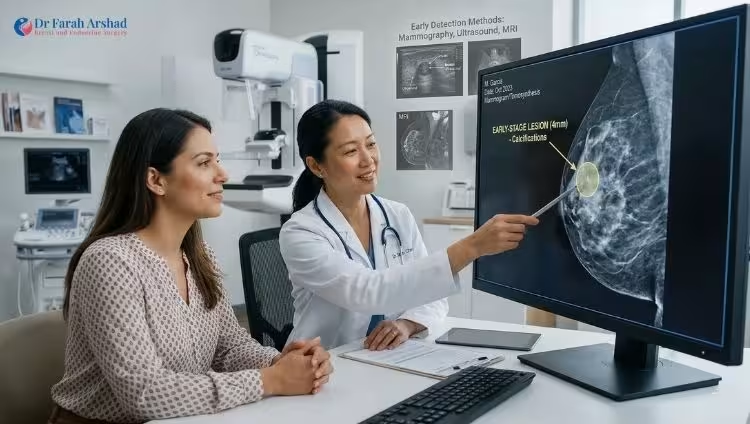
Posted By Dr Farah Arshad | Female Breast Cancer Surgeon, Lucknow
When it comes to Diagnosing Breast Cancer Early stage is not just a medical phrase; it is a life-saving reality. As a breast cancer surgeon in Lucknow, I often tell my patients that finding cancer early is like catching a small spark before it turns into a wildfire. In its earliest stages, breast cancer is highly treatable, and the chances of a full recovery are excellent.
But how exactly do we find something that is often too small to feel? How does a doctor confirm a diagnosis when there are no obvious symptoms?
In this guide, I, Dr Farah Arshad, will walk you through the journey of breast cancer diagnosis. We will explore the tools, the tests, and the latest medical advances that help us protect women’s health in 2026.
Why Early Detection Matters So Much
The goal of early diagnosis is to find cancer when it is still “localized”—meaning it hasn’t spread outside the breast. In the medical world, we call this Stage 0 or Stage 1.
Why is this important?
-
More Treatment Options: In the early stages, we can often perform breast-conserving surgeries (lumpectomies) rather than removing the entire breast.
-
Less Aggressive Therapy: Patients diagnosed early may sometimes avoid heavy chemotherapy.
-
Higher Survival Rates: The five-year survival rate for localized breast cancer is nearly 99%.
As a breast cancer surgeon in Lucknow, I have seen how timely intervention changes lives. The diagnostic process is a team effort between the patient and the medical experts.
Step 1: The Patient’s Role – Breast Self-Examination (BSE)
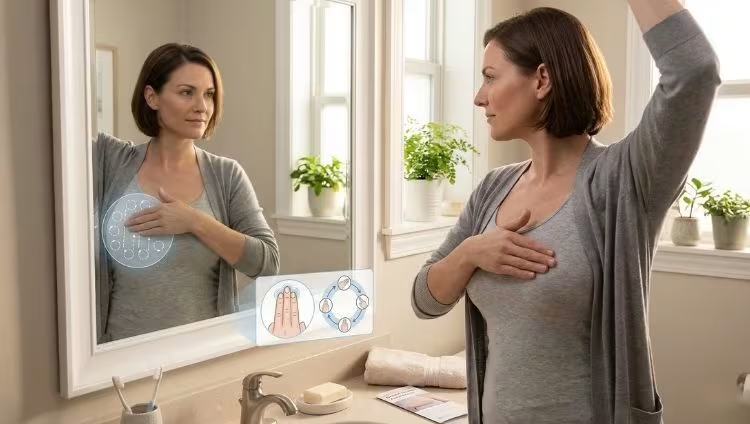
The first line of defense is you. While modern machines are powerful, many women find abnormalities themselves.
I recommend every woman above the age of 20 perform a Breast Self-Examination (BSE) once a month. The best time is 3 to 5 days after your period ends, when the breasts are least likely to be lumpy or tender.
What should you look for?
-
A new lump or a “thickened” area in the breast or armpit.
-
Changes in the size or shape of the breast.
-
Skin changes, such as dimpling (it looks like the skin of an orange).
-
Redness, scaling, or flaking on the nipple area.
-
The nipple pulling inward (retraction).
-
Any discharge other than breast milk, especially if it is bloody.
If you notice any of these, don’t panic. Most lumps are benign (not cancer). However, you should book an appointment with a specialist immediately.
Step 2: The Clinical Breast Exam (CBE)
The next step is a physical check-up by a doctor. During a Clinical Breast Examination, I use my hands to carefully feel the breast tissue and the lymph nodes in the armpit and collarbone area.
Experienced doctors can often tell the difference between a simple cyst (a fluid-filled sac) and a solid mass. However, a physical exam is never enough to confirm a diagnosis. It is simply the “trigger” for more detailed imaging tests.
Step 3: Screening Mammography – The Gold Standard
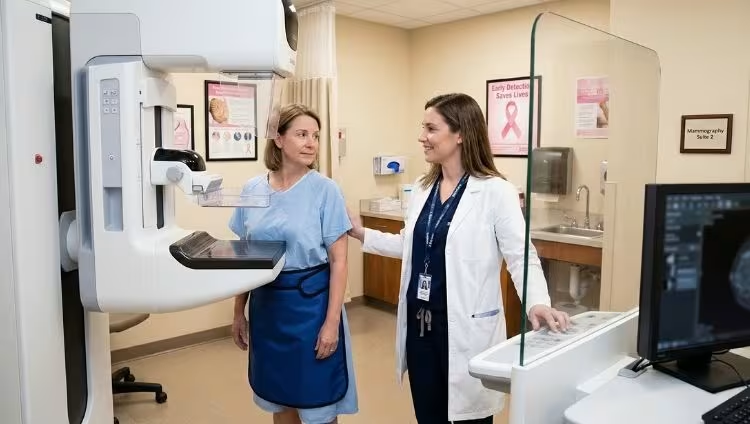
A mammogram is essentially an X-ray of the breast. It is the most effective tool we have for finding cancer before a lump can even be felt.
In 2026, we have moved beyond basic X-rays.] We now use Digital Breast Tomosynthesis (3D Mammography). This technology takes multiple images of the breast from different angles and creates a 3D model. It allows us to “see through” dense breast tissue, which often hides small tumors in younger women.
When should you get a mammogram?
Current 2026 guidelines recommend:
-
Average Risk: Women should start annual or biennial (every two years) mammograms at age 40.
-
High Risk: If you have a family history of breast cancer, you may need to start much earlier—sometimes as early as age 30.
As a dedicated breast cancer surgeon in Lucknow, I advocate for regular screening because it catches “calcifications”—tiny white spots that can be the very first sign of ductal carcinoma in situ (DCIS), the earliest form of breast cancer.
Step 4: Breast Ultrasound – Looking Deeper
If a mammogram shows something suspicious, or if a woman has very dense breast tissue, we use a Breast Ultrasound.
Ultrasound uses sound waves to create pictures of the inside of the breast. It is excellent at:
-
Distinguishing between cysts and solids: A cyst is usually harmless, while a solid mass needs more investigation.
-
Guiding a biopsy: It helps us see exactly where to put a needle to take a sample.
Step 5: Breast MRI – The Detailed View
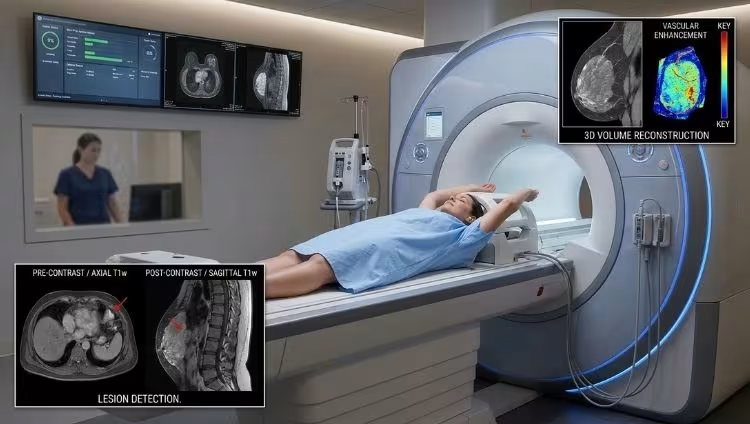
A Breast MRI (Magnetic Resonance Imaging) is not a routine test. It is usually reserved for:
-
Women at very high risk (those with the BRCA1 or BRCA2 gene).
-
Evaluating the extent of cancer after it has already been diagnosed.
-
Checking the other breast for hidden tumors.
MRI provides incredibly detailed images and is very sensitive, meaning it rarely misses a tumor.
Step 6: The Definitive Answer – The Biopsy
Imaging can tell us that something looks like cancer, but only a biopsy can tell us for sure if it is cancer.
During a biopsy, a small sample of tissue is removed from the suspicious area. In the past, this meant surgery. Today, as a breast cancer surgeon in Lucknow, I use minimally invasive techniques:
-
Core Needle Biopsy: A hollow needle is used to remove “cores” of tissue. This is the most common method.
-
Fine Needle Aspiration (FNA): A very thin needle is used to draw out fluid or cells.
-
Vacuum-Assisted Biopsy: This allows us to take multiple samples through one small entry point.
Once the tissue is out, a pathologist looks at the cells under a microscope. They determine if the cells are cancerous and, if so, what type they are.
The “Triple Test” for Accuracy
To ensure we never miss a diagnosis or provide a wrong one, doctors use the Triple Test. This includes:
-
The physical (Clinical) exam.
-
Imaging (Mammogram or Ultrasound).
-
The Biopsy.
When all three results match, we can be nearly 100% certain of the diagnosis.
Modern Diagnostics in 2026: What’s New?
Medicine never stands still. Today, we are using even more advanced ways to catch cancer early:
1. Liquid Biopsies (ctDNA)
We can now detect tiny pieces of cancer DNA floating in a patient’s blood. This “liquid biopsy” is a breakthrough for early detection and for monitoring if a cancer is coming back after treatment.
2. Artificial Intelligence (AI)
In many advanced centers, AI software now assists radiologists in reading mammograms. The AI can spot patterns that the human eye might miss, increasing the accuracy of early detection.
3. Genetic Testing
If you have a strong family history of cancer, we can test your blood for genes like BRCA1 and BRCA2. Knowing you have these genes allows us to create a customized “High Risk” screening plan, often including annual MRIs.
Why You Should Consult a Specialist Early
If you find a lump or get an abnormal report, the next person you see should be a specialist. As a breast cancer surgeon in Lucknow, my role is not just to operate, but to guide you through this complex diagnostic journey.
Choosing a specialized surgeon ensures:
-
Oncoplastic Expertise: If surgery is needed, we focus on removing the cancer while maintaining the natural look and shape of the breast (scarless or cosmetic surgery).
-
Multidisciplinary Care: We work with oncologists and radiologists to create a personalized plan.
-
Compassion: A diagnosis is scary. Having a doctor who explains every step in simple terms makes a world of difference.
Breast Cancer Awareness in Lucknow
In my years of practice as a breast cancer surgeon in Lucknow, I have observed that many women delay their check-ups due to fear or a lack of awareness. Many think, “It doesn’t hurt, so it can’t be cancer.”
Fact: Early-stage breast cancer rarely causes pain.
Waiting for pain is waiting too long. I regularly conduct screening and awareness programs in Lucknow to help women understand that their health is their priority. A healthy woman means a healthy family.
Conclusion: Take Charge of Your Health
Breast cancer is a challenge, but with early diagnosis, it is a challenge we can win. By combining your own self-exams with regular clinical screenings and modern imaging, we can find cancer at its most curable stage.
If you are over 40, schedule your mammogram today. If you feel anything unusual, don’t wait. Science and surgery have come a long way, and as your breast cancer surgeon in Lucknow, I am here to help you every step of the way.
Frequently Asked Questions (FAQs)
1. Does a lump in the breast always mean cancer?
No. In fact, about 8 out of 10 breast lumps are not cancer. They are often benign cysts, fibroadenomas (solid but harmless tumors), or infections. However, any new lump must be checked by a doctor to be safe.
2. Are mammograms painful?
Mammograms can be slightly uncomfortable because the breast needs to be compressed for a few seconds to get a clear image. However, it is not “painful” for most women, and the discomfort lasts only a few moments.
3. Can I get breast cancer even if no one in my family has had it?
Yes. Roughly 85% of breast cancers occur in women with no family history of the disease. While genetics play a role, lifestyle factors and aging are more common causes.
4. What is the difference between a screening mammogram and a diagnostic mammogram?
A screening mammogram is a routine check for women who have no symptoms. A diagnostic mammogram is a more detailed X-ray used when a woman has a symptom (like a lump) or when a screening mammogram shows something suspicious.
5. Why should I see a breast surgeon instead of a general surgeon?
A specialized breast cancer surgeon in Lucknow, like Dr Farah Arshad, has specific training in the latest oncoplastic techniques. This means they focus specifically on breast health and can offer more precise diagnosis and cosmetic surgical results that preserve the breast’s appearance.
About the Author:
Dr Farah Arshad is a renowned Breast and Endocrine Surgeon based in Lucknow. With over 30 years of experience and international training from Singapore General Hospital, she specializes in oncoplastic surgery and early cancer detection. She is currently the Associate Director of Breast and Endocrine Surgery at Max Super Speciality Hospital, Lucknow.
