



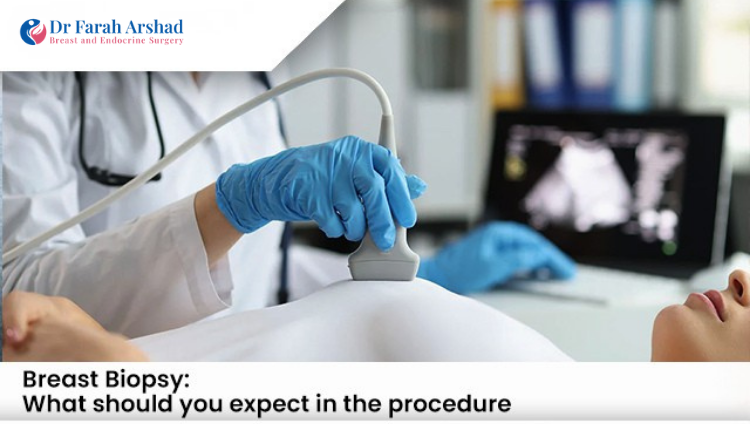
Breast Biopsy: What It Is, How It Works, and What Nobody Tells You
Posted By Dr. Farah Arshad | Breast Cancer Specialist in Lucknow
If your doctor has recommended a breast biopsy procedure, it’s completely normal to feel nervous. You probably have a lot of questions — Does it hurt? How long does recovery take? What do the results mean?
This guide answers all of that, honestly and simply. No medical jargon. No false reassurance.
Why Is a Breast Biopsy Done?
A biopsy is done when imaging — like a mammogram or ultrasound — finds something suspicious in the breast. A small tissue sample is taken and sent to a lab to check whether the cells are normal, benign (non-cancerous), or cancerous.
But a biopsy does more than just confirm cancer. It also tells doctors:
Whether the cancer is early stage or has spread, what type of cancer it is, whether it responds to hormones, and whether targeted therapies will work. All of this shapes the entire treatment plan. Without a proper biopsy, doctors are working blind.
Types of Breast Biopsy
Fine Needle Aspiration (FNA) uses a very thin needle to draw out cells. It’s quick and minimally invasive, but it has limits — it can’t always tell whether cancer is early or has spread deeper. It also misses things if the needle doesn’t hit the right spot.
Core Needle Biopsy is the most commonly used method. A slightly thicker needle removes small tissue cores. It gives more information than FNA and is usually done under local anesthesia. Most women find it tolerable.
Vacuum-Assisted Biopsy removes a larger amount of tissue and is particularly useful when calcifications (tiny calcium deposits) are found on a mammogram. It’s more accurate for borderline findings but carries a slightly higher risk of bruising or bleeding.
Surgical Biopsy is used when other methods haven’t given a clear answer, or when the result doesn’t match what imaging showed. It leaves a scar and can affect the appearance of the breast, so it’s only done when truly necessary.
Does a Breast Biopsy Hurt?
Most websites say “mild discomfort.” That’s not always true, and patients deserve an honest answer.
The local anesthetic injection can cause a brief burning sensation. During the procedure, you may feel pressure but usually not sharp pain. After the biopsy, a deep aching feeling can last 48 to 72 hours. Bruising is common and often looks worse than it feels.
Pain depends on where the lump is located, how anxious you feel going in, your hormonal cycle, and whether you’ve had previous breast surgeries. “Painless” is an exaggeration. “Manageable” is accurate.
What Happens After the Biopsy?
Recovery is usually straightforward. You’ll be advised to apply ice, wear a supportive bra, and avoid heavy lifting for a few days.
However, some things can go wrong that most guides don’t mention. A blood clot (hematoma) can form under the skin. In rare cases, an infection can develop. Weeks later, a condition called fat necrosis — where fatty tissue hardens — can create a new lump. This lump is benign, but it often causes alarm and leads to repeat scans. It’s worth knowing about this in advance so you don’t panic if it happens.
What If the Results Are “Borderline”?
This is where things get complicated, and most patient guides go quiet.
Sometimes, biopsy results are not a clear yes or no. Conditions like atypical ductal hyperplasia (ADH) or papillary lesions sit in a grey zone. A core biopsy might show ADH, but when the tissue is surgically removed, it turns out to be early-stage cancer. This is called an upgrade, and it happens more often than people realize.
This doesn’t mean biopsies are unreliable. It means that borderline results need careful follow-up and specialist review — not just a reassuring phone call.
What Is Imaging–Pathology Discordance? (And Why It Matters)
This is one of the most important things you should know, and almost no general health website explains it.
Imaging and biopsy results must match. If your scan looked highly suspicious but the biopsy report says “normal tissue,” that is not a reassuring result. That is a mismatch — called discordance —, and it requires either a repeat biopsy or surgical removal.
Many missed cancers happen exactly here. Someone gets a biopsy, the report says benign, and everyone moves on. But if the imaging and pathology don’t agree, moving on is a mistake.
Always ask your doctor: “Do the scan findings and biopsy results match?”
Long-Term Things Patients Are Rarely Told
Scar tissue from a biopsy can make future mammograms harder to read. A small metal clip is often placed at the biopsy site to mark it — this clip can shift over time. Post-biopsy fibrosis can occasionally mimic a new lump on imaging, causing unnecessary worry. For younger women with dense breasts who undergo multiple biopsies over the years, cumulative scarring is a real consideration.
None of this means you should avoid a biopsy when one is needed. It just means you should be informed.
When a Biopsy Is NOT Needed
Not every lump needs to be biopsied. A simple fluid-filled cyst on ultrasound, a lump that has been stable for years with clear imaging, and obvious fat necrosis with matching scan results generally don’t require biopsy. Over-biopsying causes scarring, psychological harm, and unnecessary procedures. The skill lies in knowing when to investigate and when to observe — and that takes experience.
Special Situations Worth Knowing
For younger women, breast tissue is denser, which means more false positives on imaging and more biopsies overall. Managing anxiety alongside the physical process matters.
For older patients, it’s worth asking whether the biopsy result will actually change the treatment plan. If not, a less invasive approach may be appropriate.
For women on blood thinners, there is a risk of bleeding during and after the procedure. Stopping the medication too early can increase stroke risk. This needs to be carefully planned with your full medical team.
Frequently Asked Questions
1. How long does a breast biopsy procedure take?
The actual procedure usually takes between 15 and 30 minutes. Most of that time is preparation and administering local anesthesia. You’ll likely be in and out of the clinic within an hour.
2. Will I need someone to drive me home after a breast biopsy?
You won’t be under general anesthesia for a needle biopsy, so technically, you could drive. However, it’s strongly recommended to bring someone with you — both for emotional support and because mild soreness or shakiness after the procedure is common.
3. How long does it take to get biopsy results?
Most results come back within 3 to 7 working days. If your sample is sent for additional testing, like hormone receptor or HER2 status, it may take slightly longer. Don’t hesitate to follow up with your doctor if you haven’t heard back.
4. Can a breast biopsy spread cancer?
This concern comes up often. The short answer is: it is extremely unlikely. There have been theoretical concerns about needle track seeding, but it is considered clinically very rare. Surgeons are aware of this and typically remove the biopsy site during definitive surgery. The benefit of accurate diagnosis far outweighs this minimal risk.
5. What happens if my biopsy comes back benign?
A benign result is good news — but it’s not always the end of the story. Your doctor should confirm that the biopsy result matches what was seen on imaging. If there is any mismatch, further evaluation may be needed. You may also be scheduled for a follow-up scan in 6 months to ensure the area remains stable.
Talk to a Breast Specialist Who Will Give You Real Answers
A biopsy is not just a procedure. It’s the foundation of every decision that follows — your diagnosis, your treatment, your peace of mind.
If you’ve been told you need a breast biopsy, or you’re unsure about a result you’ve received, you don’t have to navigate it alone.
Dr. Farah Arshad is a dedicated breast specialist based in Lucknow with experience in diagnosing and managing the full range of breast conditions — from benign lumps to complex cancer cases. She believes in explaining things clearly, addressing your concerns honestly, and making sure nothing is missed.
Whether you need guidance on whether a biopsy is necessary, a second opinion on a borderline result, or support planning next steps after a diagnosis, Dr. Farah Arshad is here to help.
Book your consultation today and get the clarity you deserve.
Your health decisions should be based on complete information — not just reassurance.
