




Introduction
Hearing “you have breast cancer” can be one of the most difficult moments in a woman’s life.
After the initial shock, many questions can come to mind:
What should I do now? Do I need surgery? Will I need chemotherapy? Should I get a second opinion? Which reports should I take to my doctor? How soon should treatment begin?
If you are feeling confused, you are not alone.
A new breast cancer diagnosis can involve several reports, medical terms, specialists and treatment decisions. The good news is that you do not need to understand everything or make every decision on the same day.
The first step is to understand your diagnosis, collect your medical reports and meet the appropriate breast cancer specialist. Your treatment plan is based on factors such as the type and stage of cancer, tumor grade, hormone receptor status, HER2 status and other individual findings.
As Dr Farah Arshad, Breast Cancer Specialist in Lucknow, explains, the period immediately after diagnosis should focus on understanding your condition and planning the next steps rather than making decisions based on fear or someone else’s experience.
At a Glance: What Should You Do After a Breast Cancer Diagnosis?
| What to Do | Why It Matters |
| Stay calm and avoid rushed decisions | You need time to understand your diagnosis |
| Collect all medical reports | Your doctor needs complete information |
| Understand your pathology report | It provides important details about the cancer |
| Check ER, PR and HER2 status | These biomarkers can influence treatment planning |
| Understand your stage | Staging helps doctors plan treatment |
| Meet the appropriate specialists | Breast cancer care may involve several specialists |
| Ask about additional tests | Some patients need more information before treatment |
| Consider a second opinion | Another specialist can review your diagnosis and treatment plan |
| Prepare questions for your appointment | It helps you understand your options |
| Discuss the treatment plan | Treatment depends on your individual cancer |
1. First, Take a Breath and Avoid Making Decisions in Panic
A cancer diagnosis can make everything feel urgent.
You may immediately start searching online for survival rates, treatment costs, chemotherapy experiences or other patients’ stories.
Try to slow down.
Your diagnosis is personal, and another woman’s breast cancer may be very different from yours.
Two women can both have breast cancer but have different:
- Tumor sizes
- Cancer types
- Stages
- Tumor grades
- ER and PR status
- HER2 status
- Lymph node involvement
- Overall health
- Treatment needs
This is why copying another patient’s treatment plan is not appropriate.
Your first goal should be:
Understand your own diagnosis before deciding what treatment you need.
2. Collect All Your Breast Cancer Reports
One of the most useful things you can do after diagnosis is to keep all your medical information together.
Create a physical folder or digital folder containing:
- Biopsy report
- Histopathology report
- IHC report
- Mammography report
- Ultrasound report
- MRI report, if performed
- Blood test reports
- Previous breast imaging
- Previous medical records
- Current medication list
- Previous treatment records, if any
Your pathology report is particularly important because it provides information about the cancer and helps your doctor plan treatment.
Why Should You Keep the Original Reports?
If you consult another specialist or seek a second opinion, the doctor may need to review your pathology report, slides or tissue material, imaging and other medical information.
NCI specifically notes that these materials may be needed when another doctor reviews a breast cancer diagnosis and treatment plan.
So, don’t throw away old reports after receiving a summary.
Keep everything organized.
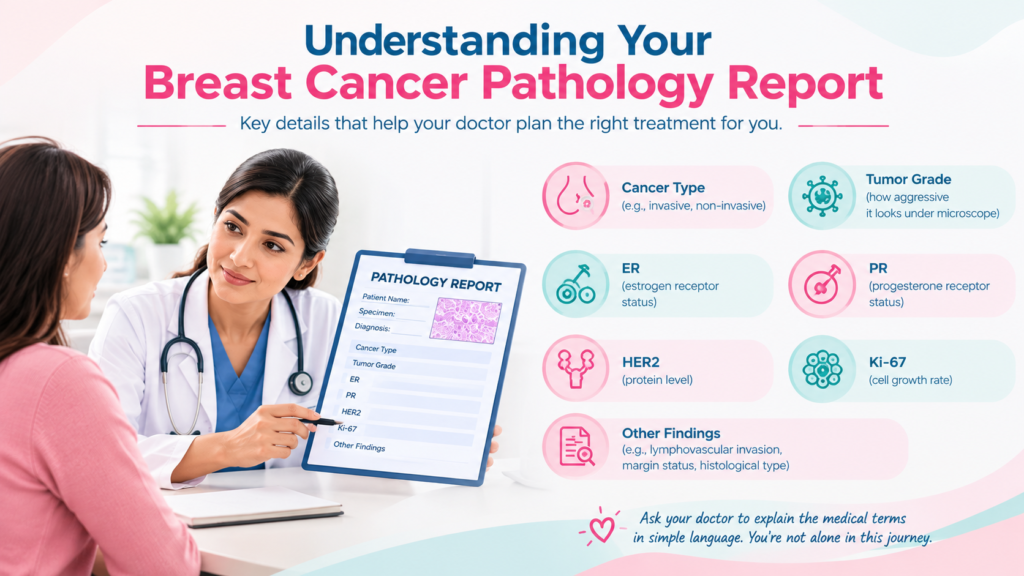
3. Understand What Your Pathology Report Says
A pathology report can contain medical terms that are difficult to understand.
You may see words such as:
- Invasive carcinoma
- Tumor grade
- ER
- PR
- HER2
- Ki-67
- Lymphovascular invasion
- Histological type
You do not need to become a pathologist to understand your diagnosis.
Instead, ask your doctor to explain the important findings in simple language.
The pathology report can provide information about where the cancer started, tumor grade and whether the cancer is invasive. Breast cancer tissue is also commonly tested for biomarkers that help with treatment planning.
A Simple Question to Ask
“Doctor, can you please explain the important parts of my pathology report and tell me what they mean for my treatment?”
That one question can help you understand your situation much better.
4. Know Your ER, PR and HER2 Status
If you have recently been diagnosed with breast cancer, you may hear your doctor mention ER, PR and HER2.
These are important biomarkers.
ER – Estrogen Receptor
If breast cancer cells have estrogen receptors, they may use estrogen signals to grow.
PR – Progesterone Receptor
PR tells doctors whether the cancer cells have progesterone receptors.
HER2
HER2 is a protein involved in cell growth. Some breast cancers have higher levels of HER2, and HER2 status can help determine whether HER2-targeted treatment may be appropriate.
Breast cancer biomarker testing commonly includes ER, PR and HER2, and these results can help doctors determine treatment options.
Why Does This Matter?
Breast cancer is not one single disease.
The biological characteristics of the tumor can affect which treatments may be useful.
This is why you should not assume:
“My relative had breast cancer, so my treatment should be the same.”
Your tumor’s biology matters.
5. Find Out Your Breast Cancer Stage
Another important question after diagnosis is:
“What stage is my breast cancer?”
Staging helps doctors understand how extensive the cancer is and is an important part of treatment planning.
Depending on the individual situation, doctors may evaluate:
- Tumor size
- Nearby lymph nodes
- Whether cancer has spread elsewhere
- Tumor grade
- Biomarker results
- Other relevant clinical information
NCI notes that breast cancer staging involves several factors and helps guide treatment planning.
Questions You Can Ask Your Doctor
- What is my breast cancer stage?
- What does this stage mean?
- Are lymph nodes involved?
- Do I need any additional tests?
- Is my cancer localized or has it spread?
- Does my stage affect the order of treatment?
Do not try to determine your stage from one report alone.
Your doctor interprets the complete clinical picture.
6. Ask Whether You Need Additional Tests
Not every woman with breast cancer needs the same tests.
Depending on your diagnosis, your doctor may recommend additional imaging, pathology review, biomarker testing or other investigations.
The purpose is to collect enough information to make an appropriate treatment plan.
For example, additional information may be needed to understand:
- The extent of the disease
- Lymph node involvement
- Tumor characteristics
- Biomarkers
- Whether a particular treatment may be appropriate
NCI explains that additional testing may be used after diagnosis to determine how far the cancer has spread and to help plan treatment.
Do Not Assume You Need Every Cancer Test
You may read about PET scans, CT scans, MRI, genetic tests or other investigations online.
That does not mean you personally need all of them.
Ask:
“Why do I need this test, and how will the result change my treatment plan?”
That is a much more useful question than simply asking for every available test.
7. Understand Who Will Be Part of Your Treatment Team
Breast cancer treatment can involve different specialists.
Depending on your diagnosis, your care may involve:
- Breast surgeon
- Medical oncologist
- Radiation oncologist
- Radiologist
- Pathologist
- Plastic or reconstructive surgeon, when appropriate
- Genetic counsellor, in selected situations
- Other healthcare professionals
Breast cancer treatment can involve local treatments such as surgery and radiation and systemic treatments such as chemotherapy, hormone therapy or targeted treatment. The combination depends on the type and stage of cancer.
Why Can Several Specialists Be Involved?
Each specialist may contribute a different part of the treatment plan.
You may therefore hear different terms such as:
Surgery → Medical treatment → Radiation → Reconstruction → Follow-up
This does not necessarily mean that you need every treatment.
It means your care may involve coordinated decision-making based on your individual diagnosis.
8. Ask: “What Is the Goal of My Treatment?”
One of the most important questions you can ask your doctor is:
“What is the goal of this treatment?”
Your doctor can explain:
- Why the treatment is recommended
- What benefit is expected
- What alternatives may exist
- What side effects may occur
- How long treatment may take
- How doctors will monitor your response
Breast cancer treatment can involve more than one type of therapy, and treatment choices depend on the cancer’s characteristics and extent.
Treatment May Include
| Treatment | General Role |
| Surgery | Removes cancer from the breast and/or evaluates or treats lymph nodes when appropriate |
| Radiation therapy | Uses radiation to treat specific areas |
| Chemotherapy | Uses medicines that can treat cancer cells throughout the body |
| Hormone therapy | Used for certain hormone receptor-positive cancers |
| Targeted therapy | Targets specific features of cancer cells |
| Other systemic treatments | May be appropriate for selected breast cancer types |
The exact treatment combination is not the same for every woman.
9. Should You Get a Second Opinion?
This is one of the most common questions after a cancer diagnosis:
“Should I get a second opinion?”
A second opinion can be considered if you want another specialist to review your diagnosis or proposed treatment plan.
The second doctor may:
- Agree with the original diagnosis
- Agree with the treatment plan
- Suggest additional information
- Recommend a different treatment approach
NCI states that a second opinion can involve reviewing pathology reports, slides, scans and other medical information.
A Second Opinion Does Not Mean You Distrust Your Doctor
Some women worry that asking for another opinion will offend their doctor.
You can simply say:
“I would like another specialist to review my case so that I can understand all my treatment options.”
The purpose is to become better informed.
If you seek a second opinion, take your complete medical records with you.
10. Prepare Questions Before Your Breast Cancer Appointment
Cancer appointments can involve a lot of information.
It is easy to forget questions once you are sitting in front of the doctor.
Write them down beforehand.
15 Questions You Can Ask Your Breast Cancer Specialist
- What type of breast cancer do I have?
- What is my stage?
- What does my pathology report mean?
- What are my ER and PR results?
- What is my HER2 status?
- Do I need any additional tests?
- Are my lymph nodes involved?
- What treatment do you recommend?
- Why do I need this treatment?
- Will I need surgery?
- Will I need chemotherapy or radiation?
- Are there alternative treatment options?
- What side effects should I expect?
- Should I consider a second opinion?
- When should my treatment begin?
These types of questions are consistent with NCI’s patient guidance for discussing diagnosis, treatment choices, specialists, timing and second opinions.
What Should You Take to Your First Breast Cancer Consultation?
A little preparation can make your appointment easier.
Take With You:
- All biopsy reports
- Pathology and IHC reports
- Mammogram and ultrasound reports
- Imaging CDs or digital images, if available
- MRI reports, if performed
- Blood test reports
- Previous medical records
- List of current medicines
- List of allergies
- Your written questions
- A trusted family member or friend, if you prefer
You can also write down the doctor’s answers.
NCI recommends preparing questions in advance and encourages patients to ask for explanations in simpler language when medical terms are confusing.
What Should You NOT Do After a Breast Cancer Diagnosis?
A diagnosis can make you vulnerable to misinformation.
Try to avoid these common mistakes.
1. Do Not Compare Your Treatment With Another Woman’s
Her cancer may have different biomarkers, stage or other characteristics.
2. Do Not Start Supplements Without Telling Your Doctor
Some medicines, herbs or supplements can interact with cancer treatment.
Tell your healthcare team about everything you are taking.
3. Do Not Stop Prescribed Treatment on Your Own
If you have concerns about a medicine or treatment, discuss them with your doctor first.
4. Do Not Rely Only on Internet Stories
Online experiences can be useful for emotional support, but they are not a substitute for an individualized medical assessment.
5. Do Not Assume “More Tests” Always Means “Better Care”
Ask your doctor how a proposed test will affect your diagnosis or treatment plan.
6. Do Not Feel You Have to Make Every Decision Immediately
Ask your doctor how much time you have to consider the available options.
What About Work, Family and Everyday Life?
Breast cancer affects more than your medical reports.
You may also be thinking about:
- Your job
- Children
- Family responsibilities
- Treatment costs
- Travel
- Time away from work
- Emotional stress
- Household responsibilities
These concerns are worth discussing with your healthcare team.
NCI encourages patients to tell their care team about concerns, including financial worries, and to ask questions about working and daily activities during treatment.
You do not have to solve all of these problems on the same day.
Try to break the journey into smaller steps:
Diagnosis → Reports → Specialist consultation → Treatment planning → Treatment → Follow-up
Focus on the next step rather than trying to predict the entire journey.
How Soon Should Breast Cancer Treatment Begin?
This is another question that can cause anxiety.
The appropriate timing depends on your individual diagnosis and treatment plan.
Some patients may need additional information or testing before treatment begins. In other cases, the treatment plan may be clear soon after diagnosis.
Instead of asking only:
“How quickly can I start treatment?”
also ask:
“Is there any information we still need before deciding my treatment?”
and:
“When do I need to make a treatment decision?”
NCI includes treatment timing among the questions patients may want to discuss with their cancer care team.
Breast Cancer Diagnosis: What Matters Most?
After a diagnosis, it is easy to become overwhelmed by medical terminology.
Keep these five things in mind:
|
Focus On |
Why It Matters |
| Your pathology report | Helps define the cancer |
| Your stage | Helps determine the extent of disease |
| ER, PR and HER2 | Important biomarkers for treatment planning |
| Your treatment team | Different specialists may contribute to care |
| Your questions | Helps you understand your options |
The aim is not to become an expert overnight.
The aim is to understand enough to participate confidently in your healthcare decisions.
What If You Feel Scared After Your Diagnosis?
Feeling frightened, confused or emotionally overwhelmed after a cancer diagnosis is understandable.
You may have days when you want to know everything and other days when you do not want to discuss cancer at all.
Give yourself some space.
Talk to people you trust.
Write down your questions instead of keeping them in your head.
And remember:
You do not need to understand your entire treatment journey on the day you receive your diagnosis.
Start with the next appointment.
Then the next decision.
Then the next step.
What Does Dr. Farah Arshad Recommend After a Breast Cancer Diagnosis?
As a Breast Cancer Specialist in Lucknow, Dr. Farah Arshad emphasizes the importance of understanding the individual diagnosis before deciding on treatment.
A breast cancer diagnosis should be assessed using the available clinical, imaging and pathology information. Biomarker results such as ER, PR and HER2 can also be important in treatment planning.
For a woman who has just received a diagnosis, the practical priorities are simple:
Collect your reports.
Understand your diagnosis.
Meet the appropriate specialist.
Ask questions.
Understand your treatment options.
Consider a second opinion when appropriate.
Then make a treatment plan with your healthcare team.
Most importantly, do not compare your diagnosis with someone else’s.
Your treatment should be based on your own medical information.
Frequently Asked Questions
1. What should I do first after being diagnosed with breast cancer?
Start by collecting your biopsy, pathology, imaging and other medical reports. Then meet an appropriate breast cancer specialist to understand your diagnosis, stage and treatment options.
2. What reports should I take to a breast cancer specialist?
Take your biopsy and pathology reports, IHC report, mammogram, ultrasound, MRI if performed, blood tests, previous medical records and current medication list.
3. Why are ER, PR and HER2 important in breast cancer?
ER, PR and HER2 are important biomarkers that can help doctors understand the biology of breast cancer and plan appropriate treatment.
4. Should I get a second opinion after breast cancer diagnosis?
A second opinion can be useful if you want another specialist to review your diagnosis or proposed treatment plan. The second specialist may agree with the original plan or suggest another approach.
5. Do I need chemotherapy after breast cancer diagnosis?
Not every woman needs chemotherapy. Treatment depends on factors such as cancer type, stage, tumor characteristics and biomarkers. Your specialist can explain whether chemotherapy is appropriate for your particular diagnosis.
6. Does every breast cancer patient need surgery?
Treatment varies between patients. Surgery is an important treatment for many breast cancers, but the overall treatment plan depends on the individual cancer and may involve other therapies as well.
7. How can I prepare for my breast cancer consultation?
Keep all medical reports together, prepare a list of medicines, write down your questions and consider taking a trusted family member or friend with you.
8. Can I ask my doctor to explain my pathology report?
Absolutely. You should ask your doctor to explain unfamiliar medical terms in simple language. It is also okay to ask the same question more than once.
9. Should I search online about my breast cancer?
Reliable medical websites can help you understand general information, but online information cannot replace an individualized medical consultation. Avoid making treatment decisions based only on another patient’s experience.
10. How soon should I start breast cancer treatment?
The timing depends on your diagnosis and treatment plan. Ask your doctor whether additional tests or pathology information are needed before treatment and when a treatment decision should be made.
Final Takeaway: You Do Not Have to Figure Everything Out at Once
Being diagnosed with breast cancer can make the future feel uncertain.
But you do not have to solve everything on the same day.
Start with the basics:
Collect your reports.
Understand your pathology.
Know your stage and biomarkers.
Meet the right specialist.
Ask questions.
Understand your treatment options.
Consider a second opinion when appropriate.
And remember:
Your breast cancer treatment should be based on your individual diagnosis—not someone else’s experience.
If you have recently been diagnosed with breast cancer, discussing your reports and treatment options with a qualified breast cancer specialist can help you understand what comes next and make informed decisions about your care.
Consult Dr. Farah Arshad
Breast Cancer Specialist & Breast Surgeon in Lucknow
📞 +91 98388 29426
🌐 https://drfaraharshad.com/
