



Posted by Dr Farah Arshad | Breast Cancer Surgeon in Lucknow
Breast cancer is one of the most common cancers affecting women in India. And when a patient first hears the word “breast cancer stages,” it brings a wave of fear and confusion.
As a breast cancer surgeon in Lucknow, I — Dr. Farah Arshad — have sat with hundreds of women and their families who had the same questions: What does my stage mean? Will I survive? What happens next?
This guide is written in simple, plain language. No medical jargon. Just clear answers.
First — What Does “Stage” Actually Mean?
Staging tells us WHERE the cancer is in your body. It does not tell us everything about the cancer.
Doctors use something called the TNM system:
T = Tumour size N = Lymph node involvement (are the nodes affected?) M = Metastasis (has it spread to other organs?)
Here is the most important thing to understand: two patients can have the exact same stage and have very different outcomes. Stage tells us the location of cancer. Biology tells us how it behaves. Both matter.
This is why a detailed personal evaluation by an experienced breast cancer surgeon in Lucknow is so much more valuable than reading a stage number online.
Breast Cancer Stages at a Glance
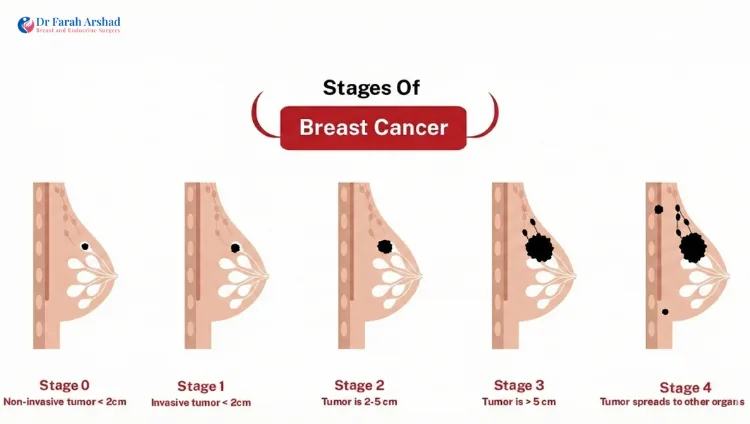
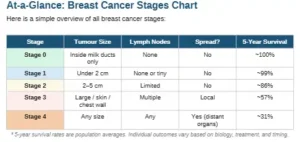
Stage 0 — Abnormal cells inside milk ducts only. No spread. Survival near 100%. Stage 1 — Small tumour (under 2 cm). No significant node involvement. Survival ~99%. Stage 2 — Tumour 2–5 cm or limited node involvement. Survival ~86%. Stage 3 — Large tumour, multiple nodes, possible skin or chest wall involvement. Survival ~57%. Stage 4 — Spread to distant organs (bone, liver, lung, brain). Survival ~31%.
Note: These survival figures are population averages based on older data. Individual outcomes are often better, especially with today’s treatments.
Stage 0 — Cancer That Has Not Yet Spread (DCIS)
Stage 0 is called DCIS — Ductal Carcinoma In Situ. It means abnormal cells have been found inside the milk ducts, but they have not invaded the surrounding breast tissue, and they have not spread anywhere.
Survival is close to 100%.
But that does not mean it can be ignored.
Some Stage 0 cases are very slow-growing and may never cause harm. Others are biologically aggressive and can turn into invasive cancer. The problem is, we cannot always tell which is which — not yet.
This is why regular screening matters so much. And if DCIS is found, it needs careful evaluation by a breast cancer surgeon in Lucknow like Dr. Farah Arshad to decide the right treatment approach — not too much, not too little.
Stage 1 — Small Tumour, Big Opportunity
At Stage 1, the cancer has crossed the duct wall and become invasive. But the tumour is still small — usually under 2 cm — and has not significantly spread to lymph nodes.
This is the best stage to catch breast cancer.
Treatment usually involves surgery, radiation, and sometimes hormone therapy. Chemotherapy may or may not be needed. As a breast cancer surgeon in Lucknow, Dr. Farah Arshad uses genomic testing — such as Oncotype DX — to personalise each patient’s treatment plan rather than giving everyone the same approach.
One important point: two patients with the same Stage 1 tumour size can need very different treatment, based on their tumour’s biology. Stage alone does not decide everything.
Stage 2 — The Stage Where Most Women First Feel a Lump
Stage 2 means the tumour is between 2 and 5 cm, or lymph nodes are involved, or both.
This is the most common stage at which women in Lucknow first come to see me. Many of them had noticed subtle signs months earlier — but delayed evaluation.
Delaying at Stage 2 does not just mean the tumour gets bigger. It increases the chance of microscopic cancer cells escaping into the bloodstream — before we can even detect them. That is the risk that most people do not fully understand.
Stage 2 is still very treatable. But timing matters. If something feels different in your breast — a lump, thickening, skin change, nipple change — please do not wait.
Stage 3 — Locally Advanced But Still Treatable
Stage 3 breast cancer is larger, involves more lymph nodes, and may involve the skin or chest wall. But it has NOT spread to distant organs.
Treatment is more intense at this stage, but it can still be curative.
The typical sequence is:
Step 1 — Chemotherapy first (called neoadjuvant chemotherapy) to shrink the tumour. Step 2 — Surgery after chemotherapy. Step 3 — Radiation therapy. Step 4 — Targeted or hormone therapy as needed.
Here is something important that most people do not know: if the tumour disappears completely after chemotherapy — what we call a pathologic complete response — the prognosis improves dramatically. This response tells us a great deal about the biology of the cancer.
As a breast cancer surgeon in Lucknow, Dr. Farah Arshad monitors each patient’s response closely and adjusts the treatment plan at every step.
Stage 4 — Metastatic Breast Cancer
At Stage 4, cancer has spread to distant organs — bone, liver, lungs, or brain. The treatment goal shifts from cure to control.
But this is not the same as giving up.
With modern targeted therapies, many patients with Stage 4 breast cancer — especially those with hormone-positive or HER2-positive cancer — live 5 to 10 years or longer. Stage 4 management is a long-term journey, not a single event.
What Stage 4 patients deal with long-term:
Bone weakening from certain medications. Heart monitoring if on targeted drugs. Emotional burnout for patients and caregivers. Financial stress of ongoing treatment.
Dr. Farah Arshad works with a full multidisciplinary team to manage all of these challenges — not just the cancer itself.
Why Biology Matters More Than Stage Alone
This is one of the most important things I tell every patient who visits my clinic.
Two women at the same stage can have completely different futures — because their tumour biology is different.
The three main biological factors are:
Hormone receptor status (HR+ or HR−) — HR+ cancers respond to hormone therapy and tend to be slower-growing.
HER2 expression (HER2+ or HER2−) — HER2+ cancers can be aggressive, but they respond very well to modern targeted drugs.
Tumour grade — This tells us how fast the cancer cells are dividing. High-grade tumours are more aggressive regardless of size.
A small, high-grade tumour can behave worse than a much larger low-grade one. Stage tells us the geography. Biology tells us the temperament. You need to understand both.
Why Survival Rate Numbers Can Be Misleading
You will read that Stage 3 has a 57% survival rate, or Stage 4 has 31%. Here is what you need to know about those numbers:
They are based on data from 5 to 10 years ago, before many modern treatments existed. They are population averages, not personal predictions. They do not account for your specific tumour biology, your access to expert care, or your treatment adherence.
When my patients ask about survival statistics, I always say the same thing: those numbers are not your destiny. What matters is the subtype, the treatment plan, how quickly you started, and the quality of your care team. People do better than statistics every single day.
What Actually Determines Your Outcome?
It is never just one thing. Your outcome depends on all of these together:
The stage at diagnosis — your starting point. The tumour biology — how aggressive it actually is. The timing of detection — earlier means more options. Access to specialist care — an expert breast cancer surgeon in Lucknow makes a measurable difference. Treatment adherence — stopping treatment early increases recurrence risk. Your overall health — better health means better tolerance of treatment.
Everything connects. Delay diagnosis and stage progression. Ignoring early symptoms and node involvement increases. Stopping hormone therapy early and recurrence risk rises.
Life After Breast Cancer Treatment
Most guides stop after treatment ends. But breast cancer does not just end when treatment ends.
Patients at every stage live with long-term effects:
Fear of recurrence, even after Stage 1 treatment. Side effects of hormone therapy, which can continue for 5 to 10 years. Lymphedema — arm swelling after lymph node removal. Bone density loss. Changes in body image and self-confidence. Fertility concerns for younger women.
Survival is not the only goal. Quality of life after treatment matters just as much. Dr. Farah Arshad offers ongoing follow-up care, lifestyle guidance, and emotional support for all patients — not just during treatment, but long after.
Frequently Asked Questions
Q: Is Stage 2 breast cancer curable?
A: Yes, in most cases it is. With the right combination of surgery, chemotherapy (if needed), radiation, and hormone therapy, many Stage 2 patients go on to live full, healthy lives. Starting treatment promptly with an experienced breast cancer surgeon in Lucknow is the most important step.
Q: What is the difference between Stage 3 and Stage 4?
A: Stage 3 means the cancer is locally advanced — it may involve nearby lymph nodes or tissue, but it has not spread to distant organs. Stage 4 means cancer has spread to organs like bone, liver, or lungs. Stage 3 is still often treated with curative intent. Stage 4 is managed long-term to control the disease.
Q: I found a lump. Does that mean I have Stage 2 or higher?
A: Not at all. A breast lump can be a cyst, a benign growth, or even very early-stage cancer. Even if it is cancer, it could be Stage 0 or Stage 1. Do not try to guess your stage based on a lump alone. Visit a breast cancer surgeon in Lucknow like Dr. Farah Arshad for a proper examination and imaging.
Q: Can Stage 4 breast cancer patients live a long time?
A: Yes, and this surprises many people. With modern targeted therapies — especially for hormone-positive or HER2-positive cancers — many Stage 4 patients live 5 to 10 years or longer. Stage 4 is not always the end. With the right team and the right treatment, it can be managed as a long-term condition.
Q: How do I choose the right breast cancer surgeon in Lucknow?
A: Look for someone who specialises in breast surgery and oncology, works with a multidisciplinary team, uses genomic and biological testing to personalise your plan, takes time to explain your options clearly, and treats you as a whole person — not just a diagnosis. Dr. Farah Arshad provides all of this at her clinic in Lucknow.
Final Thoughts from Dr. Farah Arshad
Breast cancer staging is a starting point — not a verdict.
Stages 0 to 4 describe where the cancer is. They do not define your destiny. What shifts outcomes is early recognition, accurate biological assessment, the right treatment plan, and consistency in following through.
If you have noticed something different in your breast — a lump, a skin change, nipple discharge, unexplained pain — please do not wait. Come in. Get evaluated. Early detection is still the single most powerful tool we have.
As a breast cancer surgeon in Lucknow, my goal is not just to treat cancer. It is to make sure you understand what is happening in your body, feel supported through every decision, and come out the other side living well.
