



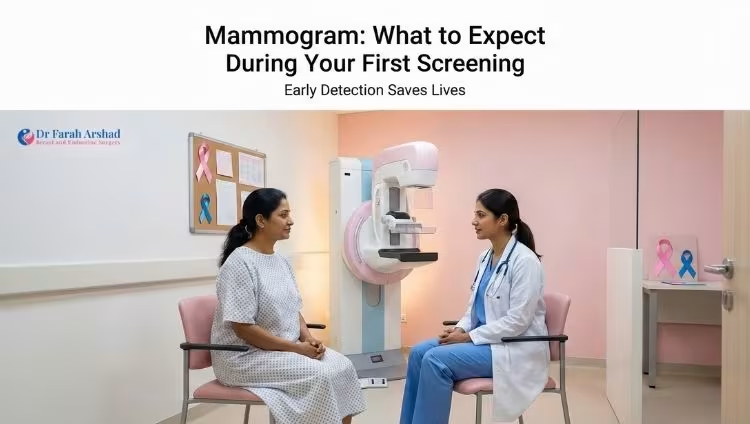
Mammogram: What to Expect During Your First Screening
Posted By Dr. Farah Arshad
Getting your first mammogram can feel scary. But most of that fear comes from not knowing what will happen. This guide will explain everything in simple words, so you can go in feeling calm and ready.
What Is a Mammogram?
A mammogram is an X-ray of your breasts. It helps doctors find cancer early, even before you can feel a lump. The whole process takes about 10 to 15 minutes. A machine gently presses your breast flat and takes pictures from two angles. A doctor called a radiologist looks at the pictures later and sends a report.
The report will say one of these things: everything looks normal, there are some harmless changes, more imaging is needed, something looks suspicious and a biopsy is needed, or a combination of these.
What Happens Step by Step
When you arrive, you fill out a form with basic information like your age, family history, any past surgeries, and whether you have any breast symptoms like pain or lumps. This information is important because it changes how the doctor reads your results. If you mention a lump or pain, the doctor looks at your images with extra care.
Then the technician positions your breast on the machine. The machine compresses or squeezes your breast. This can feel uncomfortable or even painful for a moment. But compression is necessary because it spreads the tissue evenly, reduces blurring, and helps the doctor see small changes more clearly. A good technician will make this as comfortable as possible.
After the scan, you go home and wait. The radiologist studies your images carefully, looking at shapes, edges, tiny white spots, and the overall pattern of your breast tissue. This takes skill and experience. Results usually come within a few days.
What Your Results Mean
Many women worry that being called back means cancer. That is usually not true. Especially for a first mammogram, there is no previous image to compare with, so doctors are extra careful. Being called back simply means they want a closer look.
Here is a simple breakdown of what being called back might mean:
Reason for Callback — What It Usually Means
Additional X-ray views needed — Often just a positioning issue, nothing serious
Ultrasound added — Common for dense breasts, helps tell a cyst from a solid lump
Biopsy recommended — A small tissue sample is taken to confirm, does not mean cancer
What Mammograms Cannot Do
This is the part most people are never told. A normal mammogram does not mean you will never get breast cancer. It means no problem was visible on that specific image, on that specific day.
Mammograms can miss cancers, especially in women with dense breasts. Dense breast tissue and tumors both appear white on an X-ray, making it hard to tell them apart. This is why some women also need an ultrasound.
If you notice a lump, nipple discharge, skin dimpling, or any change in your breast even after a normal mammogram, go back to your doctor. A normal report does not replace a physical exam.
The Overdiagnosis Reality
This is an uncomfortable truth that most blogs skip. Sometimes mammograms detect very slow-growing cancers that may never actually harm a person during their lifetime. But once found, these cancers are treated with surgery, radiation, or medication. This is a real ethical debate in medicine. Screening saves many lives. But it can also lead to treatment for something that may never have caused harm. Knowing this does not mean you should skip screening. It means you should have honest conversations with your doctor about your personal risk.
When Should You Start Screening?
There is no single answer that fits everyone. Different medical organizations give different advice, starting anywhere from age 40 to 45. If you have a family history of breast cancer or other risk factors, you may need to start earlier. Talk to your doctor about your personal situation, because one-size-fits-all advice does not work here.
Why Consistency Matters More Than One Perfect Scan
Your first mammogram becomes your baseline. Every mammogram after that is compared to it. Doctors can spot subtle changes over the years only because they have older images to compare with. If you switch clinics every year or skip years at random, this comparison becomes very difficult. Going to the same place regularly and keeping your records makes screening much more effective.
Common Mistakes That Reduce Accuracy
Many women unknowingly make their screening less useful. Skipping follow-up appointments after a callback is one of the most common mistakes. Ignoring symptoms after a normal report is another. Not telling the radiologist about breast implants or past surgeries can also affect results. Assuming an ultrasound can fully replace a mammogram is a misunderstanding. These two tests work differently and are often best used together.
FAQs
Question 1: Does a mammogram hurt?
It can feel uncomfortable or cause brief pain when the machine compresses your breast. The pressure lasts only a few seconds. Most women describe it as tight or awkward rather than truly painful. If you are sensitive, you can schedule your mammogram for the week after your period, when breasts tend to be less tender.
Question 2: What should I do before my mammogram?
Do not apply deodorant, powder, or lotion under your arms or on your breasts on the day of the test. These products can show up as white spots on the X-ray and confuse the results. Wear a two-piece outfit so you only need to remove your top. Bring any previous mammogram records if you have them.
Question 3: How long does it take to get results?
Most results come back within two to five days. Some clinics provide results within 24 hours. If you do not hear back within a week, call your clinic. No news is not always good news when it comes to medical tests.
Question 4: What if I have dense breasts?
Dense breasts are very common. It simply means your breast tissue has more glands and less fat. Dense tissue makes mammograms harder to read. Your radiologist may recommend an ultrasound in addition to your mammogram. Ask your doctor if you are unsure about your breast density, as this is important information for your screening plan.
Question 5: Can I skip mammograms if I feel fine and have no family history?
Feeling fine is not the same as being cancer-free. Many breast cancers have no symptoms in early stages, which is exactly why screening exists. Having no family history also does not eliminate your risk. Most breast cancers occur in women with no family history at all. Talk to your breast cancer surgeon in Lucknow about the right schedule for you, but do not skip screening simply because you feel healthy.
The Bottom Line
Your first mammogram is a starting point, not a final answer. It is one piece of information in a long-term system of care. Go in informed, not scared. Ask questions. Know your breast density. Keep your reports. Show up consistently. That is where real preventive care begins.
Final Thought
Most women walk into their first mammogram thinking it is just a routine checkup. Walk in knowing it is much more than that. It is the beginning of a relationship between you and your own health data. Every scan you do adds to a picture that becomes clearer and more useful over time.
You do not need to be afraid of what the machine might find. You need to be more afraid of never looking at all. Early detection does not just save lives in statistics and research papers. It saves real lives, real families, and real futures.
Take the appointment. Ask the questions. Understand your results. And come back next year.
That one habit, repeated consistently over the years, is one of the most powerful things you can do for yourself.
