




Nipple Discharge: A Complete Guide to Causes, Risk Assessment, and When to Seek Help
Posted by Dr. Farah Arshad | Breast Cancer Surgeon in Lucknow
Nipple discharge can be alarming, but understanding what it means—and more importantly, what it doesn’t—can help you make informed decisions about your health.
Most articles give you color charts and basic explanations. This guide goes deeper, explaining the actual mechanics, risk stratification, and clinical decision-making that matters.
Understanding the Mechanics: Where Does Discharge Come From?
Nipple discharge originates from milk ducts, not from skin or random breast tissue. When fluid appears, one of three mechanisms is at work:
- Hormonal stimulation of ducts – The most common cause in younger women
- Duct wall irritation or inflammation – Often benign but requires assessment
- Structural abnormality inside a duct – This is where pathology hides
Understanding this foundation makes everything else clearer.
The Real Risk Assessment Matrix
Color alone tells you very little. What actually matters is the pattern of discharge. Here’s the clinical framework doctors use:
Critical Assessment Questions
| Question | Higher Risk | Lower Risk |
|---|---|---|
| Which breast? | One side only | Both breasts |
| How many ducts? | Single duct | Multiple ducts |
| How does it appear? | Spontaneous (stains clothing) | Only with squeezing |
| Any lump present? | Yes | No |
| Patient age? | Post-menopausal | Reproductive years |
| Color? | Bloody or clear | Milky (bilateral) |
Discharge Colors: What They Actually Mean
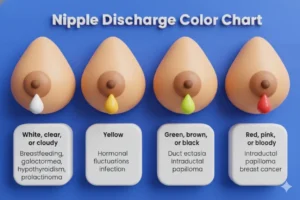
Milky Discharge (Galactorrhea)
Common causes:
- Elevated prolactin levels
- Thyroid dysfunction
- Psychiatric medications (antipsychotics, antidepressants)
- Excessive breast stimulation
The critical detail most articles miss:
Hormonal causes are typically bilateral (both breasts). If you have persistent milky discharge from ONE breast only, it still requires evaluation. Unilateral discharge changes the risk equation.
Yellow or Green Discharge
Usually caused by duct ectasia—a benign condition where milk ducts dilate and fill with thick, sticky fluid. This is common after age 40.
The nuance: Duct ectasia can look like cancer on imaging scans and sometimes coexists with early malignancy. “Just green discharge” without proper evaluation is inadequate medicine, especially from a single duct.
Clear or Watery Discharge
This is where risk gets underestimated.
Clear discharge that is:
- Spontaneous
- From one duct
- Persistent
…must be investigated with the same urgency as bloody discharge.
Clear doesn’t mean safe. The duct lining can shed watery fluid before any blood appears—that’s often when intraductal papillomas or early ductal carcinoma are present.
Bloody Discharge
The red flag everyone recognizes, but here’s the reality: most bloody discharge is still benign, often from an intraductal papilloma.
The real danger isn’t the blood itself—it’s:
- Ignoring microscopic blood
- Not localizing the exact duct
- Skipping duct excision when imaging appears normal
When Imaging Looks Normal—But Risk Remains
Here’s an uncomfortable truth in breast medicine:
| Imaging Type | Limitation |
|---|---|
| Mammography | Can miss small intraductal lesions |
| Ultrasound | May not detect tiny papillomas deep in ducts |
| MRI | Better sensitivity, but not perfect |
What happens when discharge persists but imaging is negative?
This gray zone is where experience matters. You have two options:
- Monitor closely with careful documentation
- Proceed to diagnostic duct excision
Many sources never mention this dilemma. But this is where missed cancers occur, particularly in women over 40.
The “Squeezing Trap” You Need to Know About
Patients often check for discharge repeatedly. Doctors ask them to demonstrate it. Here’s the problem:
Repeated squeezing → duct irritation → more discharge → more squeezing
You’ve created a self-perpetuating cycle.
The Critical Question
Was it spontaneous, or did you have to press?
- Must press hard = lower concern
- Stains clothes without touching = higher concern
This behavioral detail significantly changes risk assessment, yet competitors rarely mention it.
Post-Menopausal Discharge: A Different Risk Equation
After menopause, the threshold changes dramatically.
Why? Because breast tissue naturally involutes (shrinks) with age. Spontaneous duct activity becomes inherently suspicious.
Even small amounts of clear, pink, or brown discharge deserve structured evaluation in post-menopausal women.
Age-Based Risk Adjustment
| Age Group | Discharge Threshold | Clinical Approach |
|---|---|---|
| Reproductive years | Higher tolerance for physiologic discharge | Color and pattern matter most |
| Perimenopausal | Intermediate concern | Consider hormonal factors |
| Post-menopausal | Low tolerance—hormonal discharge shouldn’t occur | Even minimal discharge warrants evaluation |
When to See a Doctor: Real Decision Logic
See a Breast Specialist Urgently If:
✓ Discharge is spontaneous (happens without pressure)
✓ Only one breast affected
✓ Coming from one duct
✓ Bloody or clear in color
✓ Associated with a lump
✓ New discharge after menopause
You Can Monitor (With Documentation) If:
- Bilateral (both breasts)
- Milky in color
- Occurs only when squeezing
- No palpable lump
- Younger patient (reproductive years)
Important: Monitor doesn’t mean ignore. Document any changes and follow up if the pattern shifts.
Clinical Risk Stratification Chart
Use this framework to assess your situation:
| Risk Flags Present | Action Required |
|---|---|
| 0-1 flags | Self-monitoring acceptable; document changes |
| 2 flags | Schedule routine breast clinic appointment |
| 3+ flags | Urgent specialist evaluation within 1-2 weeks |
Risk flags:
- Spontaneous discharge
- Single duct involvement
- One breast only
- Age >40 or post-menopausal
- Bloody or clear color
- Palpable lump
- Family history of breast cancer
Edge Cases Most Sources Avoid
1. Discharge + Normal Mammogram + Strong Family History
Even with clear imaging, family history increases suspicion. Risk factors stack—they don’t cancel each other out.
2. Bloody Discharge During Pregnancy
Usually benign due to increased breast vascularity. But persistent bleeding still requires imaging. Pregnancy doesn’t make you immune to malignancy.
3. Recurrent Discharge After Papilloma Removal
If discharge returns after surgical removal, ask:
- Was the lesion completely excised?
- Was there multifocal disease?
- Was pathology reviewed thoroughly?
This is where surgical precision matters.
Treatment Approaches by Cause
| Cause | Treatment Strategy |
|---|---|
| Hormonal imbalance | Treat underlying endocrine disorder |
| Infection (mastitis) | Antibiotics, warm compresses |
| Duct ectasia | Observation or surgical excision if symptomatic |
| Intraductal papilloma | Surgical excision of affected duct |
| Malignancy | Structured oncology pathway |
The Uncomfortable Truth About Uncertainty
Sometimes a duct is surgically removed and pathology comes back benign. Patients ask: “Was surgery necessary?”
Yes—because risk cannot always be predicted non-invasively.
Medicine is about managing probability, not certainty. A small procedure now often prevents complex treatment later.
Long-Term Consequences of Ignoring Pathological Discharge
While most discharge is benign, ignoring persistent abnormal discharge can lead to:
- Delayed cancer diagnosis (months to years)
- Larger surgical resections when finally addressed
- Chronic anxiety and repeated medical visits
- Unnecessary imaging studies
The trade-off is clear: Early evaluation often means smaller interventions and better outcomes.
What Separates This Guide from Others
Most articles simplify risk into color-coded charts. Real clinical assessment uses:
✓ Pattern recognition
✓ Age-adjusted risk
✓ Single vs. multiple duct involvement
✓ Spontaneity assessment
✓ Imaging correlation
✓ Individual patient risk profile
Without this layered thinking, reassurance becomes dangerous.
Final Assessment Framework
Before you decide whether to worry, ask yourself:
- Is it spontaneous?
- One side only?
- Single duct?
- What is my age?
- Is there a lump?
- Do I have family history?
If three or more risk factors are present → seek structured evaluation.
Not Google reassurance. Not waiting to see what happens.
Nipple discharge is rarely dramatic. But when it’s pathological, it whispers before it screams.
That whisper phase is where early breast disease hides—and exactly why surface-level information isn’t enough.
Frequently Asked Questions
1. Can nipple discharge be normal?
Yes. Discharge is normal in several situations: during pregnancy and breastfeeding, in the first year after stopping breastfeeding, when caused by certain medications, or when it occurs from multiple ducts in both breasts with squeezing. However, spontaneous discharge from one duct in one breast always requires evaluation, regardless of color.
2. Should I squeeze my nipples to check for discharge?
No. Repeated squeezing causes duct irritation, which can create more discharge, leading to a self-perpetuating cycle. The critical distinction is whether discharge appears spontaneously (staining your bra or clothing) or only when you apply pressure. Spontaneous discharge is more concerning and warrants medical evaluation.
3. Does clear discharge mean cancer?
Not necessarily—most cases are benign. However, a clear, watery discharge that is spontaneous, persistent, and coming from a single duct requires the same level of investigation as a bloody discharge. Clear discharge can be an early sign of intraductal papilloma or ductal carcinoma before any blood appears.
4. I had a normal mammogram but still have discharge. Should I be worried?
Yes, you should follow up. Mammography can miss small intraductal lesions that cause discharge. If discharge persists despite normal imaging, you may need additional tests like ultrasound, MRI, or even diagnostic duct excision. This “gray zone” is where some cancers are missed, particularly in women over 40.
5. How do I know if my discharge is spontaneous or from squeezing?
Spontaneous discharge appears without any manipulation—you notice staining on your bra, nightgown, or clothing without having touched your breast. If you must press, squeeze, or manipulate your nipple to produce discharge, it’s considered “expressed” discharge, which is generally less concerning than truly spontaneous discharge.
6. I’m post-menopausal and have minimal clear discharge. Is this serious?
Post-menopausal discharge deserves prompt evaluation regardless of amount or color. After menopause, breast tissue naturally involutes (shrinks), so spontaneous duct activity is suspicious. Even minimal clear, pink, or brown discharge should trigger a structured workup because hormonal causes shouldn’t be occurring at this stage.
7. Can medications cause nipple discharge?
Yes. Several medication classes can cause discharge, particularly milky discharge (galactorrhea):
- Antipsychotic medications
- Antidepressants (especially SSRIs)
- Blood pressure medications (methyldopa, verapamil)
- Acid reflux medications (metoclopramide)
- Opioids
If your discharge is bilateral, milky, and started after beginning a new medication, discuss this with your doctor. However, medication-induced discharge should still be bilateral—unilateral discharge requires investigation regardless of medications.
8. What happens during a medical evaluation for nipple discharge?
A comprehensive evaluation typically includes:
- Detailed history (onset, color, spontaneity, associated symptoms)
- Clinical breast examination to identify the specific duct and check for lumps
- Imaging (mammogram and/or ultrasound based on age)
- Possibly MRI if initial imaging is inconclusive
- Duct excision if discharge persists with negative imaging but high-risk features
- Lab work if hormonal causes are suspected (prolactin, thyroid function)
The goal is to identify whether discharge is physiological or pathological and rule out serious causes, particularly in higher-risk presentations.
If you are experiencing nipple discharge or any unusual breast symptoms, consult Dr. Farah Arshad, Best Breast Cancer Specialist in Lucknow, for a detailed evaluation and personalized care.
