



Posted By Dr. Farah Arshad — Female Breast Cancer Specialist in Lucknow
If you or someone you love has just been told they have Stage 4 breast cancer, the first thing you need to know is this: a diagnosis is not the same as a deadline. Modern medicine has changed the story for many patients. This article explains everything clearly — no complicated medical terms, no false promises, just honest and helpful information.
What Does Stage 4 Breast Cancer Actually Mean?
Stage 4 breast cancer life expectancy means the cancer has travelled from the breast to other parts of the body. This is called metastatic breast cancer. The most common places it spreads to are the bones, liver, lungs, and brain.
But here is what most people do not realise — the location of the spread is not the only thing that matters. What matters just as much, sometimes more, is the type of cancer cells (known as ER, PR, and HER2 status), how much cancer is present in the body, how fast it is growing, how well it responds to treatment, and the patient’s overall health and previous treatments.
Two people can have Stage 4 breast cancer and have completely different journeys. That is the reality — and it is actually a reason for hope.
How Long Can Someone Live with Stage 4 Breast Cancer?
Many websites say the 5-year survival rate is around 30%. That number is real, but it does not tell the whole story. That figure includes patients who were treated 10 to 15 years ago, before many of today’s powerful medicines existed. It also mixes very different types of breast cancer — some slow-growing and some fast-growing.
Today, many patients with Stage 4 breast cancer live 5 years or more, some live 8 to 10 years, and some — especially those with hormone-positive or HER2-positive cancer — live even longer.
Stage 4 breast cancer is usually not curable. But the goal has changed. The aim is now long-term disease control — keeping the cancer stable so patients can live well for as long as possible. That shift in thinking is important.
Survival by Cancer Type — A Simple Comparison Chart
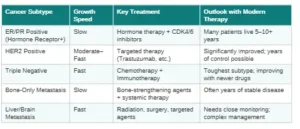
Not all Stage 4 breast cancers behave the same way. The type of cancer cells, called the subtype, is one of the biggest factors in how the disease progresses and how well treatments work. Here is a simple breakdown:
ER/PR Positive (Hormone Receptor Positive): This type grows slowly. It responds well to hormone therapy combined with newer medicines called CDK4/6 inhibitors. Many patients live 5 to 10 or more years. Resistance to treatment does eventually develop, but modern options have significantly extended survival over the last decade.
HER2-positive: This type used to be among the most aggressive. Today, targeted therapies like Trastuzumab and newer antibody-drug conjugates have transformed outcomes. Disease control can last for years. The main concern remains the risk of the cancer spreading to the brain.
Triple Negative: This is the fastest-growing subtype with the fewest treatment targets. It is the most difficult to manage in the metastatic setting. However, immunotherapy has improved outcomes for some patients in recent years.
Bone-Only Metastasis: When cancer is only in the bones, it often progresses slowly, and patients may live for many years. Bone-strengthening medicines are used alongside systemic treatment. The main risks are fractures, chronic pain, and spinal complications.
Liver or Brain Metastasis: These require fast and complex management. Liver disease can worsen quickly if the cancer burden grows. Brain metastasis needs its own separate treatment — radiation, surgery, or special medicines that can cross into the brain — because standard systemic treatments do not always reach there.
As Dr. Farah Arshad, a trusted breast cancer specialist in Lucknow, always emphasises, knowing your subtype is the very first step to building the right treatment plan for you.
What Treatments Are Used for Stage 4 Breast Cancer?
Treatment depends on the cancer subtype, where it has spread, and how the patient feels overall. The main options are hormone therapy (used for ER/PR positive cancers to block hormones that feed the tumour), targeted therapy (medicines designed to attack specific cancer cells, especially for HER2 positive cancers), chemotherapy (stronger medicines that kill fast-growing cancer cells throughout the body), immunotherapy (which helps the body’s own immune system fight the cancer), and antibody-drug conjugates (a newer type of treatment that delivers medicine directly to cancer cells with fewer side effects to healthy tissue).
Treatment is given in rounds called lines. If the first treatment stops working, doctors move to the next option. Each line tends to carry more side effects and a shorter window of benefit. This is why finding the right first treatment — and a specialist who truly understands your specific cancer — matters enormously.
More Treatment Is Not Always Better
This is something doctors discuss openly but patients rarely hear about. At a certain point, adding more aggressive treatment may reduce quality of life without adding meaningful time. Every treatment line brings additional side effects — tiredness, nerve pain, memory difficulties, financial pressure, and emotional exhaustion.
At some point, the right question becomes: is this next treatment giving more life, or taking quality away from the life that remains? This is not giving up. It is making wise, informed choices. Dr. Farah Arshad, a leading female breast cancer specialist in Lucknow, helps patients and their families navigate these difficult but important conversations with honesty and compassion.
Living with Stage 4 Breast Cancer: The Long View
For many patients, Stage 4 breast cancer is no longer a short-term situation. It has become a long-term condition — similar in some ways to managing diabetes or heart disease. Life continues. It looks different, but it continues.
Managing it well over time means going for regular scans and check-ups, cycling through different treatments as needed, planning financially for ongoing care, building emotional and psychological resilience, keeping family members informed and involved, and working closely with a specialist who knows your case in detail.
Why Early Detection Changes Everything
Most Stage 4 cases happen in one of two ways: the cancer was not caught early enough, or it returned after earlier treatment. This is why knowing the early warning signs of breast cancer is not just educational — it is potentially life-saving. Finding breast cancer before it spreads to lymph nodes or distant organs dramatically improves survival chances.
If you notice any unusual lump, skin change, nipple discharge, or unexplained breast pain, do not wait. See a specialist immediately.
Frequently Asked Questions
Q1. Is Stage 4 breast cancer always fatal?
Not immediately, and not always quickly. While Stage 4 breast cancer is generally not curable, many patients live for 5, 10, or even more years with the right treatment and care. The type of cancer, the organs affected, and how well the patient responds to treatment all shape the outcome. Modern medicine has significantly improved survival compared to even a decade ago.
Q2. What is the difference between Stage 3 and Stage 4 breast cancer?
Stage 3 means the cancer has spread to nearby lymph nodes or tissues but has not yet reached distant organs. Stage 4 means it has spread to other parts of the body such as the bones, liver, lungs, or brain. Stage 3 can still be treated with the goal of cure. Stage 4 treatment focuses on controlling the disease and maintaining quality of life for as long as possible.
Q3. Can Stage 4 breast cancer go into remission?
Yes, in some cases. Some patients experience a complete response, where scans show no detectable cancer. Doctors are careful not to use the word cured for Stage 4 disease because microscopic cancer cells may still be present. However, remission can last for years and is a very hopeful outcome. Ongoing monitoring is always necessary.
Q4. What should I ask my doctor after a Stage 4 diagnosis?
Ask your doctor about your cancer subtype (ER, PR, HER2 status), which treatment is recommended first and why, how long it is expected to work, what the side effects are, what happens when it stops working, and how you will know if it is working. Also ask whether you can maintain normal daily life during treatment. A specialist like Dr. Farah Arshad — female breast cancer specialist in Lucknow — will take the time to answer all of these questions honestly and clearly.
Q5. Where can I find expert Stage 4 breast cancer care in Lucknow?
Dr. Farah Arshad is a highly experienced female breast cancer specialist in Lucknow who provides comprehensive care for all stages of breast cancer, including Stage 4. She offers personalised treatment planning, honest guidance on what to expect, and compassionate support throughout the journey. You can book a consultation at her clinic in Lucknow, Uttar Pradesh.
Final Thoughts
Stage 4 breast cancer is serious. But it is not a single outcome. It is a journey — one that looks different for every patient depending on their cancer type, their health, and the quality of care they receive. Statistics describe groups of people. They do not describe you. Your biology, your treatment plan, and your support system all shape your path forward.
The most important step you can take right now is to get the right specialist by your side — someone who understands your cancer, respects your choices, and guides you with both knowledge and care.
Book a Consultation with Dr. Farah Arshad
Female Breast Cancer Specialist in Lucknow
Get expert diagnosis, personalised treatment, and compassionate care — all in one place. Dr. Farah Arshad has helped hundreds of patients across Lucknow and Uttar Pradesh understand their diagnosis and take control of their treatment journey.
