



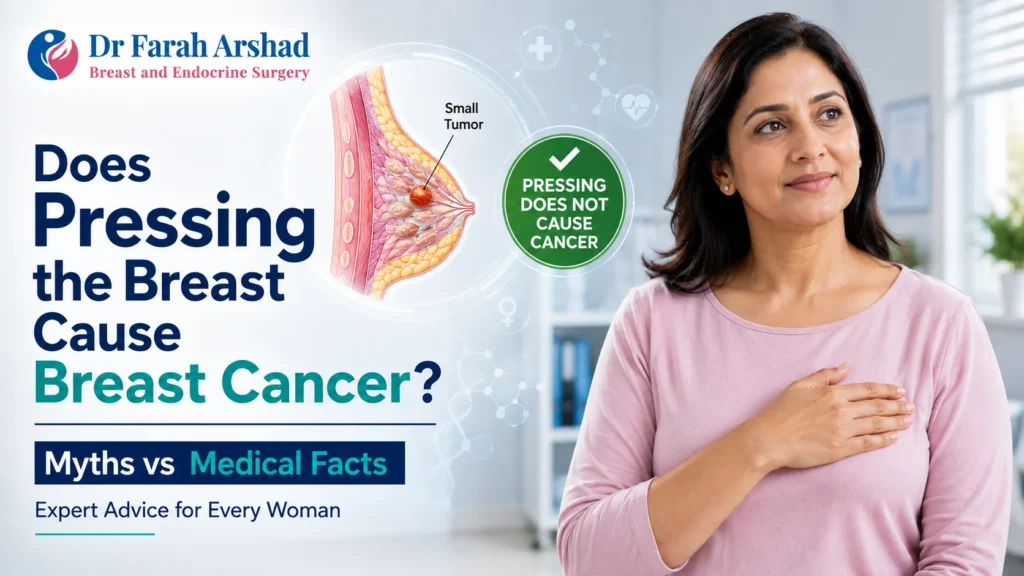
No. Pressing, touching, squeezing, or examining your breast does NOT cause breast cancer.
Many women worry that accidentally pressing their breast, sleeping on one side, wearing a tight bra, or even performing a breast self-examination might lead to cancer. Fortunately, this is a myth. Scientific research has consistently shown that breast cancer develops because of changes in the DNA of breast cells—not because of physical pressure or touching.
If you notice a new lump or any unusual change in your breast, don’t panic – but don’t ignore it either. Early evaluation by a Breast Cancer Specialist in Lucknow can help identify the cause and, if needed, begin treatment at the earliest stage.
Does Pressing the Breast Cause Breast Cancer?
Imagine accidentally bumping into a table, your child jumping on you during play, or pressing your breast while checking for a lump. A few days later, you notice soreness or discover a lump. It’s natural to wonder:
“Did pressing my breast cause cancer?”
The simple answer is No.
There is no scientific evidence that pressing, squeezing, touching, or massaging the breast can cause breast cancer.
Breast cancer develops when the DNA inside breast cells changes over time. These abnormal cells begin to grow uncontrollably and eventually form a tumor. This biological process is influenced by genetic mutations, hormones, aging, and certain lifestyle factors—not by physical pressure on the breast.
In fact, doctors encourage women to become familiar with how their breasts normally feel. Regular breast awareness and self-examination can help detect changes much earlier.
Why Do So Many People Believe This Myth?
This misconception is surprisingly common. There are several reasons why it continues to spread.
1. A Lump Is Often Discovered After an Injury
Many women first notice a lump after accidentally hitting or pressing their breast. The injury did not create the lump—it simply made them pay closer attention to that area.
2. Pain Creates Fear
A bruise or injury can cause temporary pain and swelling. Since breast cancer awareness has increased, many people immediately associate any breast discomfort with cancer.
3. Social Media Misinformation
False health information spreads quickly online. Unfortunately, many myths are repeated without scientific evidence, leading to unnecessary fear.
4. Coincidence Is Misunderstood
If cancer is diagnosed after an injury, people often assume the injury caused it. In reality, the cancer was usually already present before the injury occurred.
Myth vs Medical Fact
| Myth | Medical Fact |
|---|---|
| Pressing the breast causes cancer | ❌ False |
| Breast massage creates tumors | ❌ False |
| Mammography spreads cancer | ❌ False |
| Breast self-examination is harmful | ❌ False |
| Injury turns into breast cancer | ❌ False |
The evidence is clear: touching the breast does not cause cancer.
Can a Breast Injury Cause Breast Cancer?
Many women become anxious after accidentally hitting their breast on a door, being injured during sports, or getting bumped while carrying a child. If a lump appears afterward, it’s easy to assume the injury caused breast cancer.
The truth is reassuring: breast injuries do not cause breast cancer.
A blow to the breast can cause temporary pain, bruising, or swelling. In some cases, it may also lead to fat necrosis, a harmless condition in which damaged fatty tissue forms a firm lump. Although this lump may feel similar to a breast tumor, it is non-cancerous and can be distinguished through imaging tests such as an ultrasound or mammogram.
Why Do Some Women Discover Cancer After an Injury?
This is one of the biggest reasons behind the myth.
An injury often makes a woman touch her breast more carefully because of pain or tenderness. During this examination, she may discover a lump that had already been present but gone unnoticed.
The injury did not create the cancer—it simply led to its earlier detection.
If you notice a lump after any injury, it is still important to consult a Breast Cancer surgeon in Lucknow for a proper evaluation rather than assuming it is only a bruise.
Does Breast Self-Examination Increase Cancer Risk?
Absolutely not.
Some women avoid checking their breasts because they fear frequent touching or pressing might trigger cancer. This belief is completely false.
In fact, doctors worldwide encourage women to become familiar with the normal look and feel of their breasts. Breast self-awareness helps identify changes early, when treatment is often simpler and more successful.
Benefits of Breast Self-Examination
- Helps you become familiar with your normal breast tissue.
- Makes it easier to notice new lumps or changes.
- Encourages early medical consultation.
- Improves the chances of detecting breast cancer at an early stage.
- Gives women greater confidence in understanding their breast health.
Remember: A self-exam does not replace regular screening or mammography. It is simply an additional way to stay aware of your breast health.
What Actually Causes Breast Cancer?
Unlike the myths surrounding touching or pressing the breast, breast cancer develops because of genetic changes (mutations) within breast cells. These abnormal cells grow uncontrollably, forming a tumor over time.
Most breast cancers result from a combination of age, genetics, hormones, and lifestyle factors rather than a single cause.
Major Risk Factors for Breast Cancer
1. Increasing Age
The risk of breast cancer rises as women grow older. Most cases are diagnosed after the age of 50, although younger women can also develop the disease.
2. Family History
Having a mother, sister, daughter, or close relative with breast cancer increases your risk, especially if they were diagnosed at a young age.
3. Inherited Gene Mutations
Changes in genes such as BRCA1 and BRCA2 significantly increase the lifetime risk of breast and ovarian cancer.
4. Hormonal Factors
Early menstruation, late menopause, delayed pregnancy, or prolonged hormone replacement therapy may slightly increase breast cancer risk.
5. Obesity
Being overweight after menopause increases estrogen levels, which can contribute to breast cancer development.
6. Alcohol Consumption
Regular alcohol intake has been linked to a higher risk of breast cancer.
7. Smoking
Smoking is associated with several cancers, including breast cancer, and affects overall health.
8. Lack of Physical Activity
A sedentary lifestyle may increase the likelihood of developing breast cancer over time.
The most important takeaway is simple: pressing your breast is not a risk factor for breast cancer.
Symptoms You Should Never Ignore
While pressing the breast does not cause cancer, certain breast changes should never be ignored.
Seek medical advice if you notice any of the following:
- A new lump in the breast or underarm.
- A lump that feels hard or does not move easily.
- Persistent breast swelling or thickening.
- Bloody or clear nipple discharge.
- Nipple turning inward (inversion).
- Skin dimpling or an “orange peel” appearance.
- Redness, warmth, or persistent skin irritation.
- Changes in breast size or shape.
- A sore on the nipple that does not heal.
- Persistent breast pain associated with other symptoms.
Many breast lumps are benign (non-cancerous), but only a proper medical examination can determine the exact cause. Early diagnosis greatly improves treatment outcomes, so never delay seeking professional advice from a qualified Breast Cancer Doctor in Lucknow if you notice any unusual breast changes.
When Should You Visit a Breast Cancer Specialist in Lucknow?
Not every breast lump is cancer, and not every breast pain is a sign of a serious disease. However, some symptoms should never be ignored. Consulting a specialist early can provide peace of mind and, if necessary, ensure timely treatment.
You should schedule an appointment with a Breast Cancer Specialist if you notice:
- A new breast lump that persists for more than two weeks.
- A hard lump that does not move easily.
- Bloody or clear nipple discharge.
- A nipple that suddenly turns inward.
- Skin dimpling, thickening, or an orange peel appearance.
- Persistent redness or swelling of the breast.
- A lump in the armpit.
- A strong family history of breast or ovarian cancer.
- Any unexplained change in the size, shape, or appearance of the breast.
Remember, many breast conditions are benign. The goal of an evaluation is to determine the exact cause and rule out serious disease.
What Happens During a Breast Evaluation?
Many women feel anxious about seeing a breast specialist because they don’t know what to expect. Fortunately, a breast evaluation is straightforward and designed to identify the cause of your symptoms accurately.
1. Medical History
Your doctor will ask about:
- Your symptoms.
- When you first noticed the problem.
- Menstrual and pregnancy history.
- Family history of breast or ovarian cancer.
- Previous breast surgeries or biopsies.
- Current medications.
2. Clinical Breast Examination
The doctor will carefully examine both breasts and the underarm area to check for lumps, swelling, skin changes, or enlarged lymph nodes.
3. Breast Ultrasound
An ultrasound uses sound waves to determine whether a lump is solid or filled with fluid. It is especially useful in younger women with dense breast tissue.
4. Mammography
A mammogram is a low-dose X-ray that can detect breast cancer even before a lump can be felt.
Important: A mammogram does not spread or cause breast cancer.
5. Breast MRI (When Needed)
An MRI may be recommended for women with a high genetic risk, dense breasts, or when additional imaging is required.
6. Biopsy
If imaging suggests a suspicious area, a small tissue sample is collected and examined under a microscope. A biopsy is the only way to confirm whether a lump is cancerous.
Common Breast Cancer Myths vs Facts
Breast cancer myths often create unnecessary fear and may delay diagnosis. Let’s separate fact from fiction.
| Myth | Fact |
|---|---|
| Touching the breast causes cancer. | ❌ No. Touching or pressing the breast cannot cause cancer. |
| A painful lump is always cancer. | ❌ Most painful lumps are non-cancerous. |
| Breast cancer only affects older women. | ❌ Although risk increases with age, younger women can also develop breast cancer. |
| Men cannot get breast cancer. | ❌ Men can develop breast cancer, although it is uncommon. |
| Wearing an underwire bra causes cancer. | ❌ There is no scientific evidence supporting this claim. |
| Mammograms spread cancer. | ❌ Mammograms help detect cancer early and do not spread it. |
| Every breast lump is cancer. | ❌ Most breast lumps are benign. |
Tips to Keep Your Breasts Healthy
Although breast cancer cannot always be prevented, adopting healthy habits may help reduce your overall risk and improve your general well-being.
Maintain a Healthy Weight
Excess body fat, particularly after menopause, can increase estrogen levels and raise breast cancer risk.
Stay Physically Active
Aim for at least 150 minutes of moderate exercise each week. Activities such as brisk walking, cycling, swimming, or yoga are excellent choices.
Eat a Balanced Diet
Include:
- Fresh fruits and vegetables.
- Whole grains.
- Lean protein.
- Nuts and seeds.
- Healthy fats.
Limit processed foods, sugary beverages, and excessive red meat.
Avoid Smoking
Smoking is associated with several cancers and negatively affects overall health.
Limit Alcohol
Even moderate alcohol consumption has been linked to an increased risk of breast cancer.
Know Your Family History
If close relatives have had breast or ovarian cancer, discuss genetic counseling and earlier screening with your doctor.
Attend Regular Screening
Women over 40—or earlier if at high risk—should discuss mammography schedules with their healthcare provider.
Frequently Asked Questions
1. Can pressing the breast cause breast cancer?
No. Pressing, squeezing, touching, or examining the breast does not cause breast cancer.
2. Can breast massage lead to cancer?
No. There is no scientific evidence that breast massage increases breast cancer risk.
3. Can sleeping on one side cause breast cancer?
No. Sleeping position has no connection with breast cancer development.
4. Does mammography spread breast cancer?
No. Mammograms use a very low dose of radiation and do not spread cancer.
5. Can a child accidentally cause breast cancer by hitting the breast?
No. Minor injuries or accidental impacts cannot cause breast cancer.
6. Is breast pain always a sign of cancer?
No. Hormonal changes, infections, cysts, or muscle strain commonly cause breast pain. Persistent pain should still be evaluated.
7. Should I stop checking my breasts because of this myth?
Absolutely not. Regular breast self-awareness helps women recognize changes early and seek medical advice promptly.
8. What should I do if I find a breast lump?
Do not panic. Many breast lumps are benign. Schedule an evaluation with a qualified Breast lump specialist in Lucknow for an accurate diagnosis.
Dr. Farah Arshad’s Advice
“As a Breast Cancer Specialist in Lucknow, I frequently meet women who delay seeking medical care because they believe touching or pressing their breast caused a lump. This misconception often leads to unnecessary fear and delayed diagnosis.
The truth is simple: pressing the breast does not cause breast cancer. What truly makes a difference is recognizing unusual changes early and getting them evaluated without delay. Most breast lumps are not cancer, but every new lump deserves a professional assessment so that you can receive the right advice and treatment if needed.”
Key Takeaways
- Pressing, touching, or squeezing the breast does not cause breast cancer.
- Breast injuries may cause bruising or fat necrosis but do not create cancer.
- Breast self-examination is safe and encourages early detection.
- Most breast lumps are benign, but every persistent lump should be evaluated.
- Mammograms and breast imaging do not spread cancer.
- Healthy lifestyle habits and regular screening play an important role in breast health.
- Early diagnosis offers the best chance for successful treatment.
Conclusion
Breast cancer is one of the most common cancers affecting women, but it is also one of the most treatable when detected early. Unfortunately, myths such as “pressing the breast causes cancer” continue to create fear and confusion.
Medical science is clear: touching, pressing, massaging, or performing a breast self-examination does not cause breast cancer. Instead of avoiding breast awareness, become familiar with your normal breast tissue and seek medical advice if you notice any unusual changes.
If you discover a persistent lump, nipple discharge, skin changes, or any other concerning symptom, don’t rely on myths or home remedies. Consult a qualified Breast Cancer Specialist in Lucknow for a thorough evaluation. Early consultation can provide reassurance, identify benign conditions, or detect breast cancer at a stage when treatment is most effective.
Medical Disclaimer
This article is intended for educational purposes only and should not replace professional medical advice, diagnosis, or treatment. If you have any concerns about your breast health or notice unusual symptoms, consult a qualified healthcare professional or a breast specialist for personalized care.
