



Can Breast Cancer Be Cured Completely? What You Need to Know in 2026
By Dr. Farah Arshad, Breast Surgeon in Lucknow
Let’s talk about this honestly. Not with false hope, and not with unnecessary fear. Just clear, simple facts that every patient deserves to understand.
The word “cure” is where most people get confused. So before we answer the big question, let’s first understand what cure actually means in breast cancer.
What Does “Cured” Actually Mean in Breast Cancer?
Doctors rarely use the word “cured” casually. Instead, we say things like “no evidence of disease,” “complete response,” or “5-year disease-free survival.” The reason is simple. Breast cancer, especially hormone-sensitive types, is a slow disease. A patient can be completely fine for 8 years and then have the cancer return in year 11. This is called dormancy, and most health blogs never explain it.
So when someone asks, “Is breast cancer curable?” the honest answer is: it depends on the stage, the type, and the biology of the tumor.
When Breast Cancer Can Be Cured
In early-stage breast cancer (Stage 0 to Stage IIA), the chances of cure are genuinely high. When the tumor is small, has not spread to the lymph nodes, and has favorable biology, treatment with surgery, radiation, and medicines gives long-term survival rates above 90%. This is exactly why early detection matters so much.
But even in early stages, there is something most blogs skip entirely. At the time of diagnosis, some patients may already have very tiny cancer cells circulating in the blood that no scan can detect. These are called micrometastases. Additional treatments like chemotherapy or hormone therapy are given not just for the visible tumor, but as insurance against these invisible cells. And sometimes, even that insurance is not enough.
What About Stage 4 Breast Cancer?
At Stage 4, a complete cure is rare. But “rare” does not mean impossible. Some patients with HER2-positive breast cancer, treated with targeted drugs, go on to live 10 to 15 years or more with the disease well under control. Doctors call this a “functional cure,” meaning the cancer is there but behaving itself. Whether it counts as a true cure is something science is still working out.
What Actually Changed in 2026
There have been real advances, and it is worth knowing about them without the hype.
Antibody-drug conjugates are smarter versions of chemotherapy. They deliver the toxic drug directly to the cancer cell, causing less damage to the rest of the body. They work well, but cancer can still find ways to resist them over time.
Immunotherapy has expanded significantly, especially for triple-negative breast cancer. It works by helping the body’s own immune system attack the tumor. It does not work for everyone, and it can cause serious immune-related side effects.
Artificial intelligence is now being used in mammography and pathology to catch cancer earlier and classify tumors more accurately. This is genuinely useful, but it does not treat disease. It just helps find it sooner.
Radiation techniques have become more precise, protecting the heart and other healthy organs better than before. Quality of life has improved. Cure rates have stayed about the same.
The Part Nobody Talks About: Cancer Adapts
This is something Dr. Farah Arshad, a leading breast surgeon in Lucknow, wants every patient to understand. Cancer is not a fixed target. Under the pressure of treatment, tumor cells can mutate and change. A tumor that was originally sensitive to hormone therapy can develop resistance. HER2 expression can shift. New genetic mutations can appear. This is why cancer treatment is not a one-time event. It is an ongoing conversation between your doctor and your disease.
A true cure would mean eliminating every last cancer cell and every possibility of evolution. We are not there yet. But we are getting closer.
What About Long-Term Side Effects in “Cured” Patients?
Here is something that rarely gets discussed. A patient who is disease-free 15 years after treatment has every reason to celebrate. But they may also be living with heart damage from certain targeted drugs, thinning bones from hormone therapy, persistent arm swelling called lymphedema, or mental fog that many describe after chemotherapy. Being oncologically cured and being fully well are sometimes two different things. Survivorship care matters just as much as cancer treatment itself.
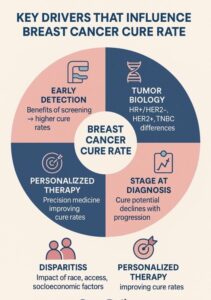
Quick Reference: Can Breast Cancer Be Cured?
| Stage / Situation | Likelihood of Cure |
|---|---|
| Stage 0 to Stage II, favorable biology | High — often curable with standard treatment |
| Stage III | Moderate — cure possible, depends on response to therapy |
| Stage IV, HER2-positive, good response | Functional cure possible in selected patients |
| Stage IV, widespread disease, aggressive type | Cure is rare; goal is long-term control |
| Late diagnosis, incomplete treatment | Outcomes significantly worse |
A Note for Patients in Lucknow and Across India
Many global articles about breast cancer assume that every patient has access to genetic testing, immunotherapy, and regular follow-up scans. The reality in India is different. Many women are still being diagnosed late. Financial pressure causes some patients to stop treatment midway. Awareness about breast self-examination remains low in many communities.
If you are in Lucknow or nearby and have concerns about a breast lump, nipple discharge, or family history of breast cancer, please do not wait. Consulting a breast surgeon in Lucknow early can make a genuine difference in outcomes. Dr. Farah Arshad sees patients at all stages and provides guidance rooted in the latest evidence, along with sensitivity to the real-world challenges patients face.
The 2026 Reality, Stated Simply
Breast cancer is increasingly treatable. It is often curable when found early. In some Stage 4 cases, it can be controlled for many years. But a universal cure for all types and all stages does not yet exist. Progress is real but incremental. And honest communication about that is something every patient deserves.
Frequently Asked Questions
1. Is breast cancer 100% curable?
In early stages with favorable tumor biology, long-term cure is very achievable, with survival rates above 90%. However, no doctor can guarantee 100% cure for any individual because every cancer is biologically unique and late recurrence is always a possibility, even after many years.
2. Can Stage 4 breast cancer be cured?
Complete cure in Stage 4 is uncommon, but some patients, particularly those with HER2-positive disease, can achieve very long-term control that doctors sometimes call a functional cure. Survival of 10 to 15 years is possible in selected cases with the right treatment.
3. What is the difference between remission and cure?
Remission means there is no detectable cancer in the body right now. A cure would mean the cancer can never return. Since breast cancer can lie dormant and return years later, doctors prefer to say remission or no evidence of disease rather than cured, to be medically accurate.
4. How long after treatment is breast cancer considered gone?
There is no fixed timeframe. For hormone-positive breast cancers, the risk of recurrence continues beyond 10 years, which is why doctors sometimes recommend hormone therapy for 5 to 10 years. For triple-negative breast cancer, the highest risk period is within the first 3 to 5 years.
5. Does finding breast cancer early really make that much difference?
Yes, significantly. Stage 0 and Stage 1 breast cancers have survival rates above 95 to 99%. By Stage 4, the goal shifts from cure to long-term control. This is why regular screening mammograms and prompt evaluation of any breast changes are so important, especially for women over 40 or those with a family history.
6. Where can I consult a breast surgeon in Lucknow?
Dr. Farah Arshad is a breast surgeon in Lucknow with expertise in both surgical and non-surgical management of breast conditions, including breast cancer. Early consultation allows for proper staging, tumor biology testing, and a treatment plan tailored to your specific case. Do not delay seeking an opinion if you notice any breast changes.
